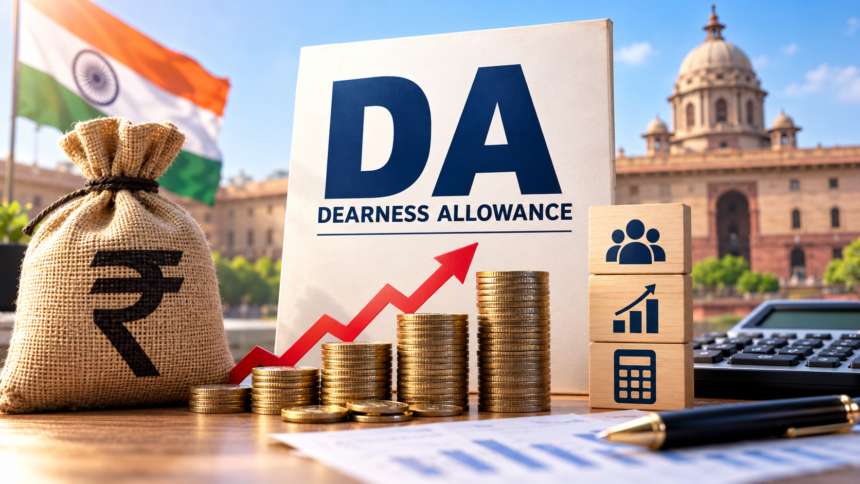
Dearness Allowance (DA) is an important component of the salary of central government employees and pensioners. It is designed to help offset the impact of inflation and rising living costs by providing an additional amount linked to basic pay.
The allowance is revised twice a year using data from the All-India Consumer Price Index (AICPI). Announcements are generally made around March and October, while revised rates typically take effect from January and July.
In April 2026, the Finance Ministry announced a 2% increase in DA for central government employees and pensioners, including railway and defence personnel. The revised rate became effective from January 1, 2026, taking DA from 58% to 60% of basic pay.
What Are the Different Types of Dearness Allowance?
Dearness Allowance is commonly divided into two categories: Industrial Dearness Allowance (IDA) and Variable Dearness Allowance (VDA).
Industrial Dearness Allowance (IDA): This applies to employees of central public sector enterprises and is reviewed quarterly, taking changes in the Consumer Price Index (CPI) into account.
Variable Dearness Allowance (VDA): This is associated with workers covered by the relevant central wage framework. Its calculation uses the Consumer Price Index and a fixed base index to account for changes in the cost of living.
Although CPI figures are published monthly, changes to VDA depend on the applicable revision mechanism and the rules governing minimum wages.
How Is a DA Hike Calculated?
DA revisions are based on inflation-related index data. Under the 7th Central Pay Commission framework, the calculation for central government employees uses the average AICPI-IW figures over the preceding 12 months.
According to ClearTax, the formulas used for calculating DA percentages are as follows.
For central government employees:
DA percentage = [(12-month average AICPI-IW, base year 2001 = 100 − 261.42) ÷ 261.42] × 100
For public sector employees:
DA percentage = [(Three-month average AICPI-IW, base year 2001 = 100 − 126.33) ÷ 126.33] × 100
The April 2026 revision was described as a 2-percentage-point increase, taking the allowance to 60% of basic pay. The supplied calculation uses a 12-month average AICPI-IW figure and the applicable reference index to arrive at a rate of approximately 60.39%, which is stated as 60%.
Under the 7th Pay Commission period, there have been 10 DA increases since 2021, with the highest reported increase being 11% in July 2021. The two previous revisions mentioned were increases of 2% in January 2025 and 3% in July 2025.
Who Is Eligible for DA Benefits?
Dearness Allowance is provided to eligible central and state government employees and pensioners. Private-sector employers in India do not generally provide DA as a standard salary component.
More than one crore government employees and pensioners are reported to benefit from DA revisions. This includes approximately 50 lakh central government employees and around 65 lakh retired central government pensioners.
The actual increase in salary or pension varies from person to person because basic pay differs across the 18 employee pay levels. As DA is calculated as a percentage of basic pay, employees and pensioners with different basic amounts receive different increases in rupee terms.
Is DA Included in Salary and CTC? What About Income Tax?
Dearness Allowance forms part of an employee’s salary and is included in the overall cost-to-company (CTC) structure where applicable. For central government employees, the allowance is credited as part of monthly salary payments.
Government rules also specify how fractional amounts are rounded. Amounts involving a fraction of 50 paise or more may be rounded up to the next rupee, while fractions below 50 paise may be disregarded.
DA is generally fully taxable as salary income. Employees must account for the allowance when calculating taxable income, and the applicable Income Tax Rules require the relevant DA component to be reported separately in income-tax returns where required.
Disclaimer: This article is for general informational purposes and is based on the information and calculation details provided. DA rates, eligibility conditions and calculation methods may vary according to the applicable government rules and employee category. Readers should consult official Finance Ministry notifications, relevant service rules or a qualified tax professional to confirm current rates, personal entitlements and tax obligations.