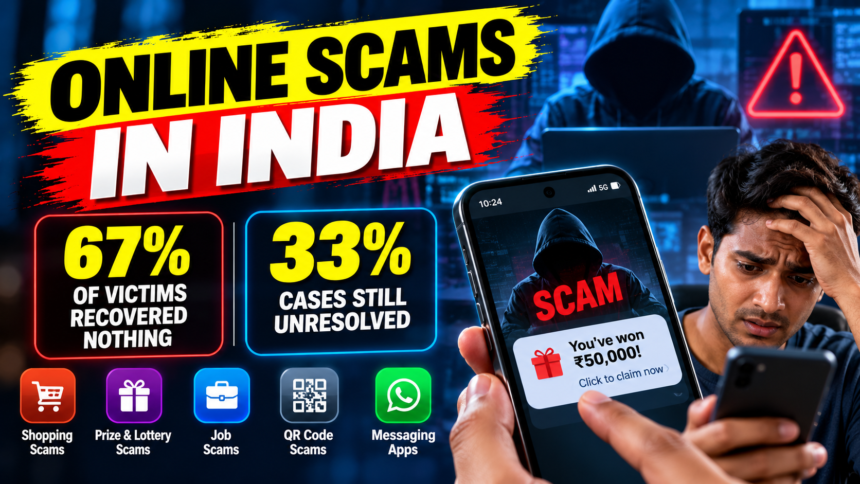
Online fraud continues to affect Indian consumers, but recovering money after a scam remains a major challenge. According to the GSMA India Consumer Scam Report 2026, 67% of victims who lost money did not recover any of it, while 33% of reported cases remained unresolved.
The report found that 86% of scam victims contacted at least one organisation for assistance. However, reporting fraud did not always lead to a successful investigation or the return of lost funds.
The findings are based on an online survey conducted by Milieu Insight between July 29 and August 3, 2026. During the survey, 12% of Indian consumers said they had experienced a scam in the previous 12 months. Another 39% reported that although they had not personally been scammed, someone close to them had fallen victim.
Which Online Scams Are Most Common in India?
Online shopping fraud emerged as the most frequently reported scam, accounting for 33% of cases experienced by Indian victims. Prize, lottery and inheritance scams followed at 31%, while job and income-related fraud accounted for 30%.
Scams involving QR codes or payment links represented 27% of reported scam types.
Messaging applications were the most common channels used to reach victims, cited by 42% of respondents. Social media platforms accounted for 37%, while email was reported by 33%.
The survey also highlighted the growing visibility of artificial intelligence (AI) in online fraud. As many as 89% of Indian consumers said they had seen AI being used in scams. AI-written messages and fake AI-generated images were each recognised by 48% of respondents, while 42% said they had encountered deepfake videos featuring real people.
How Many Scam Victims Report Fraud?
The report shows that many victims seek help from multiple organisations after discovering a scam. Nearly half of those affected, or 49%, approached the police. Meanwhile, 41% contacted their bank or e-wallet provider, and 40% reported the incident to the platform where the fraud took place.
Another 36% approached their mobile or internet service provider for assistance.
An organisation took primary responsibility for resolving 65% of reported cases. However, accepting responsibility did not necessarily mean that the investigation was completed successfully or that the victim received their money back.
According to the findings, 22% of reported cases were fully resolved, with the money returned to victims. Another 17% were partly resolved, meaning that some of the lost money was recovered.
Overall, only 33% of victims who lost money managed to recover at least part of their losses. The findings underline the continuing gap between reporting online fraud and receiving meaningful financial relief.
Are Indians Willing to Share Personal Data to Prevent Scams?
Despite concerns about online privacy, the survey suggests that many Indian consumers are comfortable allowing organisations to use their data for fraud detection.
Around 87% of respondents were comfortable with their bank or financial service provider holding and using their data to identify fraudulent activity. The corresponding figures were 82% for government agencies, 81% for mobile operators and 73% for digital platforms.
However, the findings indicate that people’s willingness to share data may be linked to how effectively their complaints are handled.
Among victims whose cases were resolved, 88% were comfortable with the government using their data. This figure fell to 64% among those whose cases remained unresolved.
A similar difference was observed for digital platforms. While 87% of victims with resolved cases were comfortable with platforms using their data, the proportion dropped to 57% among victims whose cases were unresolved.
These results suggest that successful complaint resolution may play an important role in maintaining consumer confidence in organisations involved in preventing online fraud.
What Does the GSMA India Consumer Scam Report 2026 Reveal?
The report highlights three major concerns: widespread exposure to online scams, difficulties recovering lost money and the importance of effective complaint handling.
Although most victims who sought assistance contacted at least one organisation, a substantial proportion did not recover their losses. At the same time, consumers showed considerable willingness to share data for fraud prevention, with trust varying according to whether their complaints were resolved.
The findings emphasise the difference between reporting a scam and obtaining a satisfactory outcome for the victim.
Disclaimer: This article is intended for general informational purposes only and is based on the findings and figures provided from the GSMA India Consumer Scam Report 2026. The survey results reflect respondents’ reported experiences and perceptions and should not necessarily be interpreted as representing every Indian consumer. This article does not constitute financial, legal or cybersecurity advice.