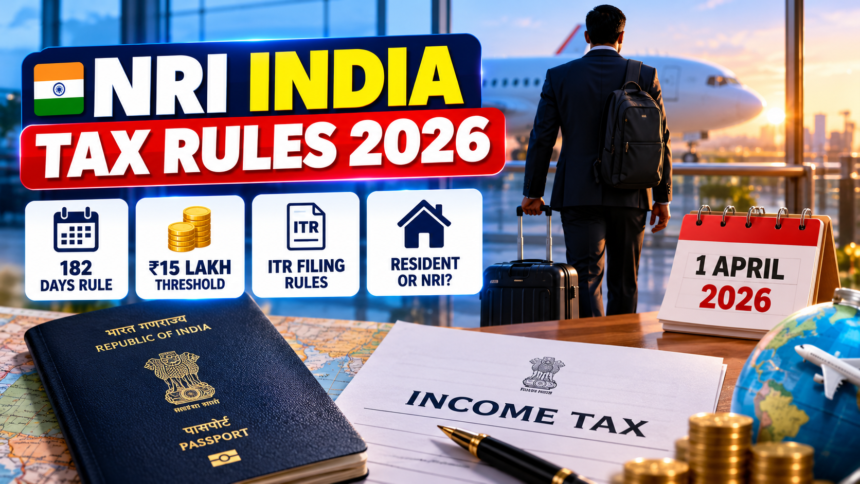
Living abroad does not automatically qualify an Indian citizen as a non-resident for income tax purposes. Residential status depends on factors such as the number of days spent in India, income earned during the year and the individual’s residential history.
Under Section 115G of the Income-tax Act, 1961, eligible non-resident Indians (NRIs) are exempt from filing an income tax return (ITR) if their total income consists only of investment income, long-term capital gains or both, subject to the applicable tax deduction at source (TDS) conditions.
The Income-tax Act, 2025, came into effect on April 1, 2026. Although the broad residential-status tests and filing requirements described here remain unchanged, Indians living overseas should understand the applicable rules to determine their tax obligations.
How Is Indian Tax Residency Determined?
Under Section 6 of the Income-tax Act, 2025, an individual is generally considered a resident of India if they stay in the country for at least 182 days during the relevant tax year.
A person may also qualify as a resident if they spend at least 60 days in India during that year and have stayed in the country for at least 365 days in the preceding four years. These conditions are the same as those provided under Section 6(1) of the Income-tax Act, 1961.
Special provisions apply to Indian citizens who leave the country for employment abroad or as crew members of Indian ships. In these cases, the alternative test involving 60 days in the relevant year and 365 days over the preceding four years does not apply. Such individuals are generally treated as residents only if their stay in India reaches 182 days during the relevant tax year.
Why Does the ₹15 Lakh Income Threshold Matter?
Different residential-status rules apply to Indian citizens and persons of Indian origin (PIOs) visiting India.
Generally, their residential status is determined using the applicable stay requirements. However, when their income other than income from foreign sources exceeds ₹15 lakh in a financial year, a modified residency test may apply.
Under this provision, the usual 60-day threshold is replaced by 120 days, provided the individual has also spent at least 365 days in India during the preceding four years.
This means that the ₹15 lakh threshold can affect how residential status is assessed for certain Indian citizens and PIOs visiting the country. The applicable conditions must be checked before determining whether an individual qualifies as a resident or non-resident.
What Is Deemed Residency Under Indian Income Tax Rules?
Indian citizens may also be classified as deemed residents under specific circumstances, even if they do not meet the usual physical-stay requirements.
This provision applies when an individual’s income, excluding income from foreign sources, exceeds ₹15 lakh during the year and they are not liable to tax in another country because of domicile, residence or a similar criterion.
Unlike the regular residency tests, deemed residency does not depend on the number of days spent in India. Individuals covered by this provision are classified as residents but not ordinarily resident (RNOR).
The rules are intended to address cases in which eligible Indian citizens with substantial income in India are not liable to tax as residents in any other country.
How Are Tax Residency Rules Applied Across 2025 and 2026?
Residential status is determined separately for each financial year. Therefore, individuals whose stay in India covers the period before and after the introduction of the Income-tax Act, 2025, must assess their status under the law applicable to each year.
For FY 2025-26, corresponding to AY 2026-27, residential status is determined under the Income-tax Act, 1961, based on the relevant stay and other applicable conditions up to March 31, 2026.
For FY 2026-27, the Income-tax Act, 2025, applies. The relevant period of stay begins on April 1, 2026. However, when applying the test involving 60 days in the current year and 365 days in the preceding four years, the individual’s stay during FY 2025-26 and earlier years must also be considered.
Indians living abroad should therefore review their travel history, income sources and tax obligations for each financial year rather than assuming that their residential status remains the same from one year to another.
Disclaimer: This article is intended for general informational purposes only and should not be considered tax or legal advice. Residential status, ITR filing exemptions and tax liabilities depend on individual circumstances and the applicable provisions of income tax law. Readers should consult the official Income Tax Department website and seek advice from a qualified tax professional before making tax-related decisions.