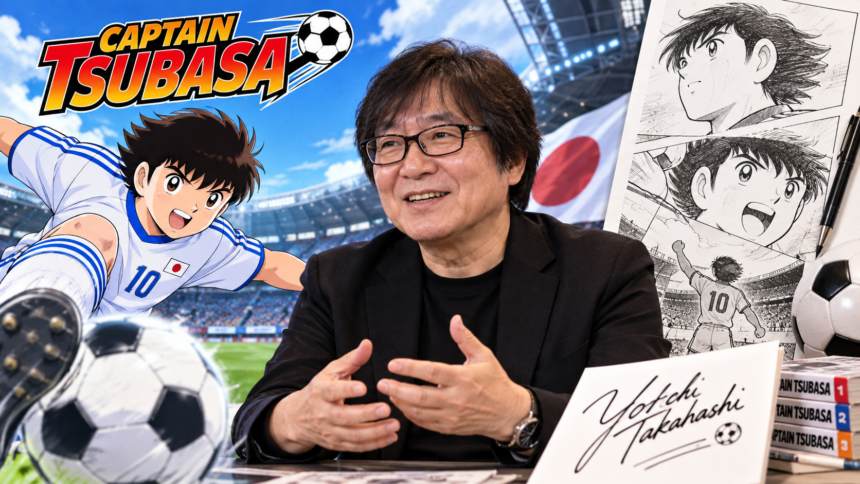
Captain Tsubasa creator Yoichi Takahashi has discussed the inspiration behind his legendary football manga, revealing how real-world football, his childhood ambitions and Japan’s growing presence in the sport shaped the series.
In an interview at San Diego Comic-Con Málaga, Takahashi reflected on the franchise’s long journey, from its beginnings in the early 1980s to its influence on generations of football fans and professional players. He also discussed the significance of Japan facing Brazil at the 2026 FIFA World Cup, a matchup that mirrored a dream he had carried since the early days of the manga.
The series has become one of the most influential sports manga ever created, helping introduce Japanese readers to football and inspiring many young people to take up the game.
How the 1978 World Cup Inspired Captain Tsubasa
Takahashi’s interest in football grew after watching the 1978 World Cup in Argentina on television while he was a high-school student in Tokyo’s Katsushika ward.
At the time, football had a relatively limited following in Japan. Takahashi wanted to create a story that would make the sport exciting and accessible to young readers. That idea eventually became Captain Tsubasa, which introduced protagonist Tsubasa Ozora in Weekly Shonen Jump in 1981.
The manga followed Tsubasa’s development as a footballer and his ambition to compete against the world’s best players. Brazil became a particularly important target in the story because of its reputation and influence in international football.
Takahashi explained that Brazil was the team Japan would ultimately need to measure itself against. Tsubasa’s journey reflected that ambition, with the character developing his skills and eventually pursuing professional football in São Paulo.
How Tsubasa’s Rivals Became Fan Favourites
Yoichi Takahashi explained that some of the most memorable characters in Captain Tsubasa were created to challenge the protagonist in contrasting ways. Goalkeeper Genzo Wakabayashi was one of his earliest ideas, built around the simple sporting drama of a goalkeeper trying to stop a striker from scoring.
Kojiro Hyuga came later as Tsubasa’s direct opposite. While Tsubasa comes from a comfortable family and is cheerful and open, Hyuga grows up in a financially struggling household and works delivering newspapers to support his football ambitions. His fierce personality creates a sharp contrast with Tsubasa’s optimism.
Takahashi said he deliberately developed opposing personalities because their clashes made the matches and overall story more compelling. Over time, however, Wakabayashi and Hyuga grew beyond their original roles and became characters who could stand alongside Tsubasa in popularity and importance.
When Captain Tsubasa’s Fiction Meets Real Football
Takahashi also discussed his connection with Nankatsu SC, a real football club named after the fictional school associated with Tsubasa.
He explained that he generally keeps his work on the manga separate from watching the real club play. Nevertheless, certain moments have created a surprising connection between the two worlds.
Takahashi recalled seeing a Nankatsu SC player score with an overhead kick. For a brief moment, the scene reminded him of Tsubasa performing a similar move in the manga.
Seeing a real footballer score a goal resembling one from his fictional world was particularly memorable for the creator. It illustrated how the spectacular football techniques and dreams depicted in Captain Tsubasa can occasionally find echoes on an actual football pitch.