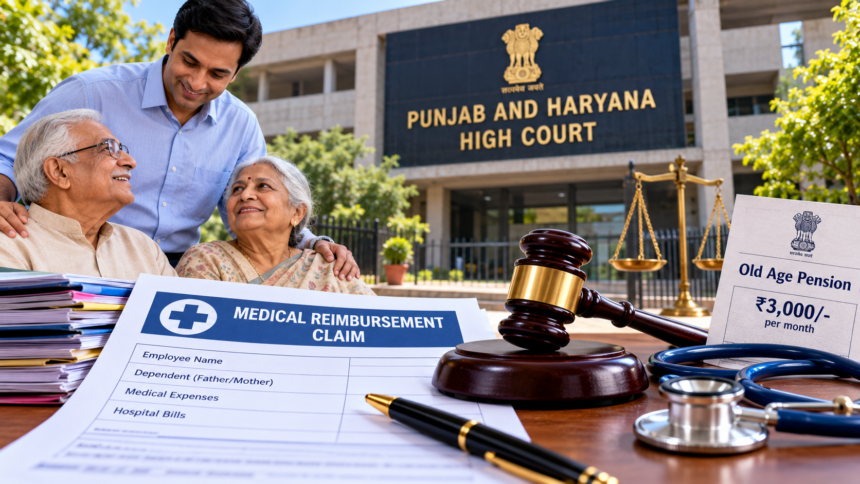
The Punjab and Haryana High Court has ruled that Haryana government employees cannot be denied medical reimbursement for their dependent elderly parents solely because they receive a monthly old-age pension of ₹3,000.
In its decision, the court set aside rejection orders in 10 connected petitions and directed the concerned authorities to process, sanction and release admissible reimbursement claims within two months of receiving a certified copy of the order.
The ruling offers relief to government employees whose elderly parents need medical treatment but receive a modest pension. It clarifies that receiving a small social-security benefit does not automatically mean that a parent can independently afford medical expenses.
Medical Reimbursement Rules Cannot Be Overridden by Administrative Instructions
The High Court observed that administrative instructions cannot take precedence over the statutory rules governing medical reimbursement. The Punjab Medical Attendance Rules, 1940, recognise dependent family members, including parents, but the relevant provisions do not prescribe a rigid monetary limit for assessing dependency.
The cases arose after authorities rejected medical reimbursement claims because the income of the employees’ dependent family members was considered higher than the limit specified in government instructions.
In one case, a government employee sought reimbursement for the treatment of his 70-year-old mother, who suffered from chronic ailments and received inpatient treatment at an empanelled, government-approved hospital. The total medical expenditure was ₹3.73 lakh.
Officials rejected the claim on the grounds that the assessed income exceeded the monthly limit of ₹3,500 set under government instructions issued in 2007.
The court noted that the treatment, medical bills and expenses were not disputed. Instead, the claim had been rejected because of the interpretation of the income limit rather than any dispute over the medical treatment itself.
Why a ₹3,000 Old-Age Pension Cannot Automatically Disqualify Parents
The court also considered a clarification issued by Haryana’s Director-General Health Services on February 3, 2025. The clarification stated that the ₹3,000 old-age pension should not be counted as income for this purpose.
The court observed that the state could not provide elderly citizens with a social-security benefit and then use their receipt of that same benefit as a reason to deny medical reimbursement through their employed children.
It further explained that dependency cannot be determined solely by looking at income. Physical condition and the need for care are also relevant, particularly when elderly parents suffer from serious or chronic illnesses and depend on their children for assistance, supervision and support.
The judgment also considered a woman’s claim for reimbursement of medical expenses incurred for her parents-in-law. The court held that denying the benefit in those circumstances was contrary to Haryana’s medical reimbursement policy.
What the High Court Ruling Means for Haryana Government Employees
The decision strengthens the position of Haryana government employees whose claims for their dependent parents’ medical treatment have been rejected solely because of a modest old-age pension or a strict interpretation of income limits.
However, the ruling does not establish an unconditional right to reimbursement for every parent who receives a pension. Claims must still be assessed under the applicable rules, taking into account the circumstances of the case, the dependency criteria and the admissibility of the medical expenses.
The High Court has directed the competent authorities to process and sanction eligible claims and release the admissible amounts within two months of receiving a certified copy of its order.
For affected employees, the decision highlights that a small pension alone should not be treated as conclusive proof that elderly parents are financially independent or ineligible for medical reimbursement.
Disclaimer: This article is intended for general informational purposes and is not a substitute for legal advice. The outcome of individual medical reimbursement claims will depend on the applicable rules, official instructions and specific circumstances. Employees seeking reimbursement should consult the relevant department or a qualified legal professional for guidance on their eligibility and claim procedures.