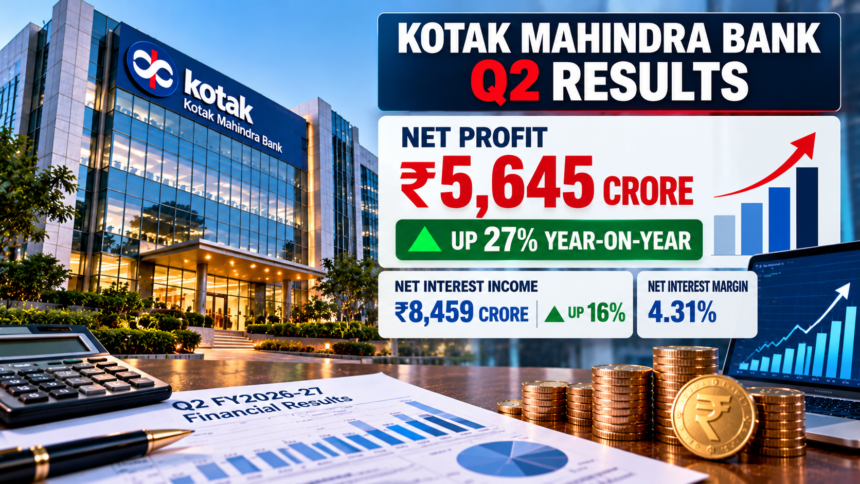
Kotak Mahindra Bank reported a strong improvement in its financial performance for the July–September quarter of FY2026–27, with consolidated net profit rising approximately 27% year-on-year to ₹5,645 crore. The bank’s standalone profit also increased, while its net interest margin declined compared with the previous quarter.
Net Interest Income Rises 16%
Kotak Mahindra Bank’s net interest income (NII) increased 16% year-on-year to ₹8,459 crore. NII measures the difference between the interest a bank earns on loans and investments and the interest it pays on deposits and borrowings.
Growth in lending helped support the bank’s core income. Domestic loans increased by around 25% year-on-year, indicating continued demand for credit across its business.
Deposits and Customer Assets Expand
The bank recorded approximately 23% growth in deposits compared with the year-earlier period. Customer assets also increased, reaching around ₹6.99 lakh crore.
Growth in deposits is important for banks because it helps fund lending activity. However, the cost of attracting and retaining deposits can also affect profitability, particularly when competition for customer funds increases.
Net Interest Margin Moves Lower
Despite stronger earnings, Kotak Mahindra Bank’s net interest margin (NIM) declined to 4.31%, from 4.53% in the previous quarter. The bank’s efforts to mobilise foreign-currency deposits were among the factors affecting its margin.
NIM is a key measure of banking profitability because it reflects how efficiently a lender earns interest relative to its interest-earning assets.
Lower Provisions Support Profit Growth
Provisions for potential bad loans declined by around 15% year-on-year. Lower provisions can support a bank’s reported profit because less money needs to be set aside to cover possible credit losses.
Investors will continue to monitor asset quality, loan growth and the bank’s ability to maintain margins as its business expands.
What Investors Should Watch Next
Kotak Mahindra Bank’s results show stronger earnings and lending growth, alongside a decline in quarterly net interest margin. Future performance will depend on credit demand, funding costs, asset quality and the wider economic environment.
A strong earnings report does not guarantee a rise in the share price. Investors should assess the bank’s valuation and longer-term performance rather than relying on one quarter’s results alone.