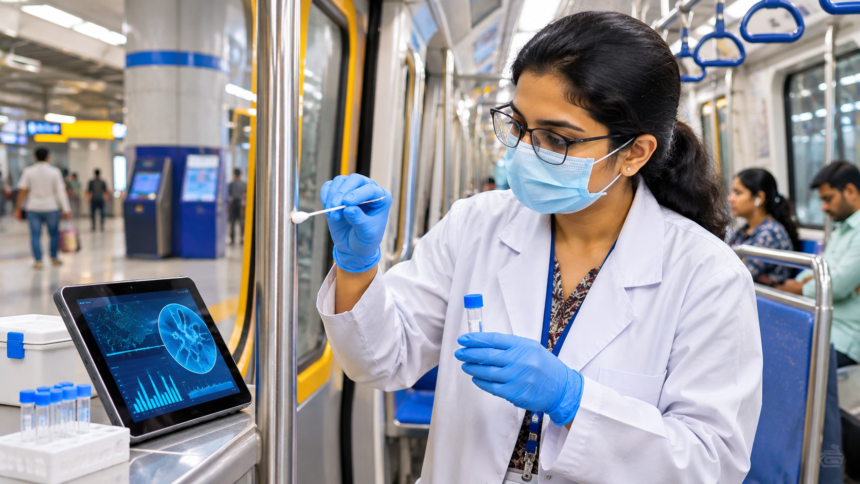
A new study by researchers at the Indian Institute of Technology (IIT) Madras has brought attention to the invisible microbial communities present inside public transport systems. Researchers have mapped microorganisms found on frequently touched surfaces across Chennai Metro stations and trains, identifying several bacterial groups and genes associated with antibiotic resistance.
The research is India’s first comprehensive study of microbial communities found on surfaces inside a public transport system. The findings could help researchers better understand how urban environments influence microbial populations and public health.
What Did the Researchers Discover?
The research team analysed microbial DNA collected from surfaces across 12 Chennai Metro stations and trains. These included handrails, ticket vending machines, station banisters and ticket counters.
Out of 41 samples included in the final analysis, more than 80% contained genetic sequences associated with antibiotic resistance, although these were detected in relatively low amounts.
Researchers also identified 72 families of antibiotic-resistance-associated genes and nine microbial species that appeared unusually common in Chennai compared with other cities.
Does This Mean Metro Passengers Are at Risk?
Researchers have clarified that detecting microbial DNA does not automatically mean that passengers are exposed to dangerous infections.
The DNA sequencing method used in the study cannot establish whether the microorganisms detected were alive or capable of spreading infections. It also cannot confirm whether the resistance-associated genes were functioning.
Therefore, the findings should be understood as an early scientific observation rather than evidence of an immediate public health threat.
Why Is This Research Important?
The study provides an initial picture of the microbial environment inside Indian public transport systems. Researchers believe that repeated testing across different seasons could help identify changes in microbial communities over time.
The findings may also support better cleaning strategies for frequently touched surfaces, including ticket kiosks, handrails and counters.
Researchers Call for Continued Monitoring
The IIT Madras research team has highlighted the importance of conducting similar studies over longer periods. Additional laboratory testing will be necessary to understand whether the detected microorganisms have any meaningful health implications.
The research also contributes to a growing international effort to understand the relationship between urban environments, microorganisms and public health.