

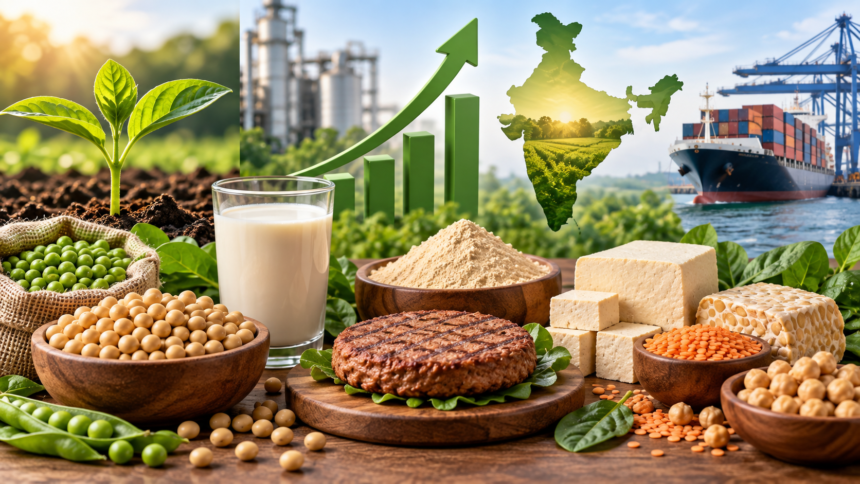
India’s plant-based protein market is entering a period of rapid expansion, with the sector expected to double from its current estimated value of around ₹4,500 crore to ₹9,000 crore within the next five years.
According to the Plant Based Foods Industry Association (PBFIA), rising consumer interest in protein, targeted nutrition and healthier food choices is expected to remain a key factor behind this growth. The industry body also highlighted the significant opportunity for Indian manufacturers to develop domestic production and reduce the country’s dependence on imported plant-protein ingredients.
India’s Plant-Based Protein Sector Growing Faster Than Global Market
The Indian plant-based food industry is reportedly expanding at around 18% annually, considerably higher than the estimated 7–8% global growth rate.
The changing priorities of Indian consumers are playing an important role in this trend. Instead of focusing primarily on calorie intake, consumers are increasingly paying attention to the nutritional value of the food they eat, with protein emerging as an important part of their dietary choices.
PBFIA Executive Director Praveer Srivastava, speaking at Fi India and ProPak India 2026, said the country is witnessing a transition towards nutrition-focused consumption.
The plant-protein ingredients segment, currently estimated at approximately ₹4,500 crore, is projected to double over the next five years if the current growth trajectory continues.
90% of Plant-Protein Ingredients Reportedly Imported
Despite the strong growth potential, India continues to rely heavily on overseas suppliers for plant-based protein ingredients.
According to PBFIA, nearly 90% of India’s plant-protein ingredients are currently imported. This dependence presents a significant opportunity for domestic manufacturers to expand production and develop India’s own plant-protein supply chain.
Srivastava pointed out that plant-based protein has been identified as one of the potential growth drivers by the Ministry of Food Processing Industries. Greater policy support could help companies establish domestic capabilities while reducing reliance on imports.
However, building large-scale ingredient extraction facilities requires substantial capital.
According to Srivastava, establishing an ingredient-extraction plant with a capacity of around 10–15 tonnes per day could require an investment of at least ₹200–250 crore.
India’s Agriculture Sector Could Give Plant Protein a Major Boost
India’s extensive agricultural base could become an important advantage for the domestic plant-protein industry.
The availability of agricultural raw materials provides an opportunity to establish stronger processing and extraction capabilities within the country. Developing this ecosystem could help Indian businesses substitute imports, attract fresh investments and increase the value generated from agricultural produce.
In the long run, stronger domestic manufacturing could also position India as a potential global supplier of plant-based food products and ingredients.
The growth of plant-based foods may also contribute to efforts aimed at developing more sustainable food systems, particularly as India works towards its target of achieving net-zero carbon emissions by 2070.
Plant Protein Part of a Much Larger Food Ingredients Market
The opportunity extends beyond plant-based protein alone. The segment forms part of India’s broader food ingredients and additives industry, which is estimated to be worth around ₹85,000 crore.
According to Prabodh Halde, Head of Technical Regulatory Affairs at Marico Ltd and West Zone Chairman of the All India Food Processors’ Association (AIFPA), the next stage of growth for the industry will require India to move further up the value chain.
Greater processing capacity, stronger export capabilities and improved cooperation between farmers, processors, research organisations and food companies could help unlock additional value.
Health and Natural Food Trends Could Create More Opportunities
The growing demand for healthier and natural food products could provide another boost to India’s food-processing ecosystem.
Kaushik Desai, Secretary General of the Health Foods and Dietary Supplements Association (HADSA), highlighted India’s agricultural resources and the rising demand for health-oriented products as key opportunities for the sector.
According to Desai, India could potentially develop into a global hub for health ingredients by combining traditional Ayurvedic knowledge with modern scientific research.
Achieving this, however, would require closer cooperation among food companies, regulators and research institutions. Scientific validation, regulatory compliance, consistent quality, sustainability and consumer confidence would all be important for the industry’s long-term development.
What the Future Holds for India’s Plant-Based Protein Market
The expected rise from ₹4,500 crore to ₹9,000 crore in five years indicates the scale of opportunity emerging in India’s plant-based protein industry.
The combination of rising protein awareness, an expanding health-conscious consumer base, India’s agricultural resources and high import dependence creates significant room for domestic production.
If investments, research, infrastructure and policy support develop alongside consumer demand, India could gradually reduce its dependence on imported plant-protein ingredients while creating new opportunities for manufacturers, farmers, food processors and exporters.
With the Indian plant-based food sector reportedly growing at 18% annually, the next five years could prove crucial in determining whether India becomes not just a major consumer market, but also a competitive producer and exporter of plant-based protein and health ingredients.