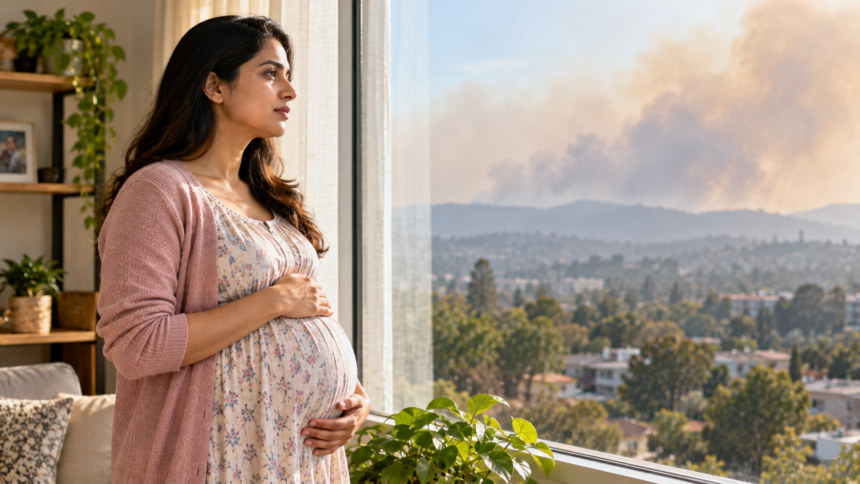
A large study has found a possible link between exposure to wildfire smoke during pregnancy and a higher likelihood of autism diagnosis in children. The findings highlight growing concerns about how environmental air pollution may affect health during pregnancy and early childhood.
Study Examines Nearly 900,000 Mother-Child Pairs
The research examined 893,212 mother-child pairs in the United States whose children were born between 2007 and 2014. Researchers estimated pregnant women’s exposure to fine particles from wildfire smoke based on the areas where they lived.
The results suggested that exposure during pregnancy, particularly in the second and third trimesters, was associated with a higher risk of an autism diagnosis by the age of eight.
Researchers found that each increase of 0.75 micrograms per cubic metre in average wildfire-related fine-particle exposure was associated with a 30% higher relative risk of an autism diagnosis. This figure describes a statistical association, not a prediction for an individual child.
Why Wildfire Smoke May Matter
Wildfire smoke contains tiny airborne particles that can travel long distances and remain in the atmosphere even after a fire has ended. These particles can enter the respiratory system and are associated with inflammation and other health concerns.
Because smoke can spread far beyond the immediate area of a fire, people may be exposed even when flames are not nearby or the smoke is not clearly visible.
The researchers said awareness of air-quality conditions during pregnancy could be an important part of conversations about environmental health.
Findings Do Not Prove Cause and Effect
The study was observational, meaning it identified a relationship between estimated smoke exposure and later diagnoses but could not establish that wildfire smoke causes autism. Other factors may also influence the results.
The research focused on families enrolled in the US Medicaid programme, so the findings may not apply equally to every population. Further research will be needed to understand the possible biological mechanisms and whether similar patterns appear in other groups.
Steps to Reduce Smoke Exposure
During wildfire-smoke events, pregnant people can follow local air-quality alerts, limit strenuous outdoor activity when pollution levels are high, and follow public-health advice for sensitive groups. Healthcare professionals can also discuss environmental risks as part of routine prenatal care.
The findings add to research into air pollution and pregnancy, but they should not be interpreted as evidence that exposure determines whether a child will be autistic.