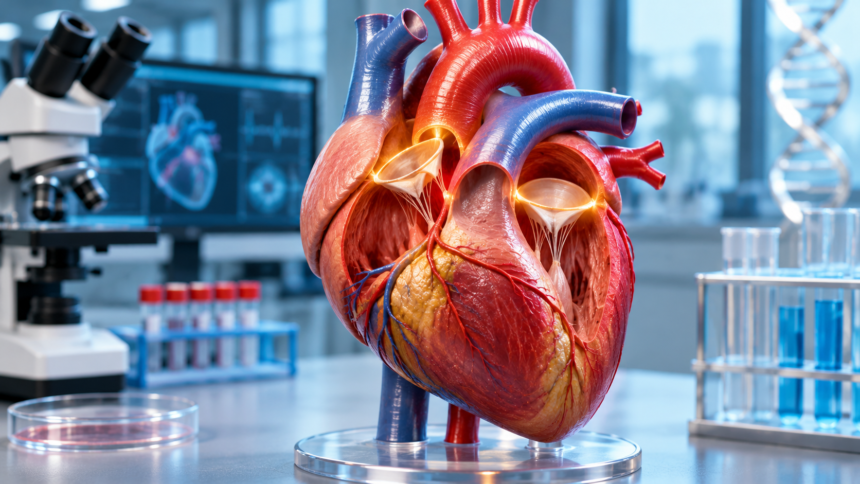
Scientists have made an important discovery about how the human heart changes with age. New research has revealed that ageing does not affect every part of the heart equally.
The study found that age-related inflammation and tissue changes are particularly concentrated in the heart valves and major blood vessels rather than being distributed evenly throughout the heart muscle.
The findings challenge earlier assumptions about cardiac ageing and could help researchers better understand why certain heart conditions become more common as people grow older.
Heart Valves and Blood Vessels Show Greater Signs of Ageing
As the human body ages, several organs gradually undergo structural and functional changes. The heart is no exception. However, researchers have now identified specific regions that appear to experience more pronounced ageing-related changes.
The study highlights two important areas:
- Heart valves: These structures help regulate the flow of blood through the heart. Researchers identified signs of increased inflammation and tissue changes in these regions.
- Major blood vessels: The large vessels connected to the heart also showed concentrated signs of ageing-related inflammation and scarring.
These findings suggest that examining the heart as a single uniform organ may overlook important differences between its individual structures.
What Is Inflammation and Why Does It Matter?
Inflammation is part of the body’s natural defence system. It helps protect tissues when the body encounters infection or injury.
However, persistent low-level inflammation can contribute to long-term health problems. In the cardiovascular system, chronic inflammation may be associated with changes in blood vessels, tissue scarring and reduced flexibility.
Researchers are particularly interested in understanding how these changes develop over time and whether certain regions of the heart are more vulnerable than others.
Could This Discovery Improve Future Heart Disease Research?
The discovery may provide researchers with a more detailed understanding of cardiovascular ageing.
If scientists can identify why inflammation and scarring are concentrated in particular regions, they may eventually be able to develop more targeted approaches to studying age-related heart conditions.
The findings could also help guide future investigations into diseases involving heart valves and major blood vessels.
Why the Research Is Important
Heart disease remains a major global health concern, and understanding how the cardiovascular system changes with age is an important part of prevention and treatment research.
The latest study provides a different perspective by showing that ageing-related changes are not necessarily uniform throughout the heart.
However, this is an early research finding, not a new treatment or a recommendation for changing medical care. Further studies will be needed to understand how these findings translate into human heart health.
The research offers an important new direction for scientists studying cardiovascular ageing and the long-term effects of inflammation.