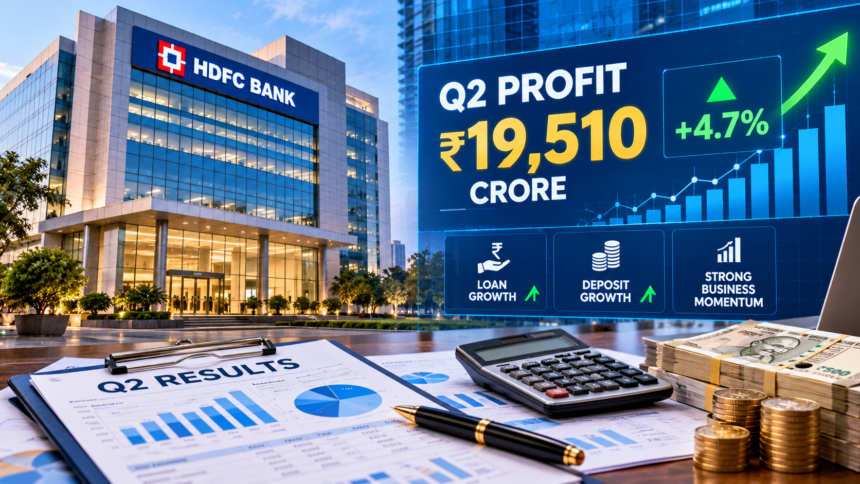
HDFC Bank reported a 4.7% year-on-year increase in standalone net profit for the second quarter of the financial year 2026–27, with profit reaching ₹19,510 crore . The performance reflected continued growth in lending and deposits, although lower treasury trading gains and higher provisions for potential bad loans affected the bank’s overall earnings.
As one of India’s largest private-sector lenders, HDFC Bank plays an important role in the country’s banking industry. Its quarterly performance provides insights into credit demand, deposit mobilisation, lending growth and asset quality.
Despite reporting higher profit than a year earlier, the bank’s earnings came in slightly below average analyst expectations. Investors are therefore likely to examine the bank’s core operating performance, funding costs and future growth prospects alongside its headline profit figures.
Net Interest Income Grows 9.7%
HDFC Bank’s net interest income (NII) increased by 9.7% to ₹34,619 crore during the quarter. NII represents the difference between the interest a bank earns from loans and other interest-bearing assets and the interest it pays on deposits and borrowings.
This measure is particularly important because lending and deposit-taking form the foundation of traditional banking operations. Growth in NII can indicate an expansion in the bank’s core business, although the result is also influenced by lending rates, deposit costs and the overall interest-rate environment.
The increase suggests that the bank continued to generate higher income from its core banking activities. Investors will be watching whether this momentum can continue while the bank manages its funding expenses and maintains competitive lending rates.
Loan and Deposit Growth Remain Strong
The bank reported a 16.3% year-on-year increase in total loans, while deposits grew by 18.8%.
Loan growth reflects credit demand from individuals and businesses. Customers may borrow for housing, vehicle purchases, personal requirements, business expansion and other financial needs. For banks, lending growth can support revenue, provided loans are priced appropriately and borrowers repay their obligations.
Deposit growth is equally important because deposits provide a major source of funding for lending activities. A strong deposit base can help banks manage liquidity and support future expansion.
HDFC Bank’s reported credit-to-deposit ratio stood at 96%. This ratio measures the proportion of deposits used to fund loans and is closely monitored when assessing a bank’s funding position.
Maintaining a sustainable balance between lending and deposits remains important. Banks must attract deposits at manageable costs while ensuring that credit growth does not create excessive pressure on liquidity.
Lower Treasury Gains Affect Other Income
HDFC Bank’s treasury trading gains declined to ₹780 crore from ₹2,390 crore in the corresponding period a year earlier. Other income fell by 3.6% to ₹13,831 crore.
Treasury income can fluctuate because of changes in market conditions and gains or losses on financial instruments. Consequently, a decline in treasury gains can affect quarterly profitability even when the bank’s core lending business continues to expand.
The figures highlight the difference between recurring banking income and income that can change substantially with market movements. Investors often examine these components separately to understand the underlying strength of a bank’s earnings.
The bank’s future profitability will depend on several factors, including loan growth, deposit costs, fee income, operating expenses and developments in financial markets.
Asset Quality Remains an Important Indicator
Provisions for potential bad loans increased by 2.1% during the quarter. Banks set aside provisions to account for possible losses when borrowers experience financial difficulties or fail to meet repayment obligations.
At the same time, HDFC Bank’s gross non-performing asset (NPA) ratio improved to 1.11% from 1.17% in the previous quarter. The gross NPA ratio measures the proportion of total loans classified as non-performing.
A lower ratio generally indicates an improvement in reported asset quality. However, investors also need to monitor fresh bad loans, recoveries, restructuring and the level of provisions maintained against potential losses.
Asset quality remains a key consideration because deterioration in loan repayments can increase provisions and affect profitability in subsequent quarters.
What Should Investors Watch Next?
HDFC Bank’s quarterly performance highlights continued growth in its lending and deposit operations, alongside fluctuations in treasury income and provisions.
Investors evaluating the bank should pay attention to the following factors:
- Net interest income: Whether the bank can maintain growth in its core lending business.
- Deposit mobilisation: Whether deposits continue growing at a healthy pace and at manageable funding costs.
- Asset quality: Whether the gross NPA ratio remains stable or improves further.
- Other income: Whether treasury income and fee-based revenue support overall profitability.
- Valuation: Whether the share price reasonably reflects earnings growth, risks and future business prospects.
The results offer useful information about the bank’s operating performance, but one quarter alone cannot determine its long-term outlook. Investors should consider the bank’s financial position, future earnings potential and their own investment objectives before making decisions.
Disclaimer: This article is for informational purposes only and does not constitute investment advice. Stock market investments are subject to market risks.