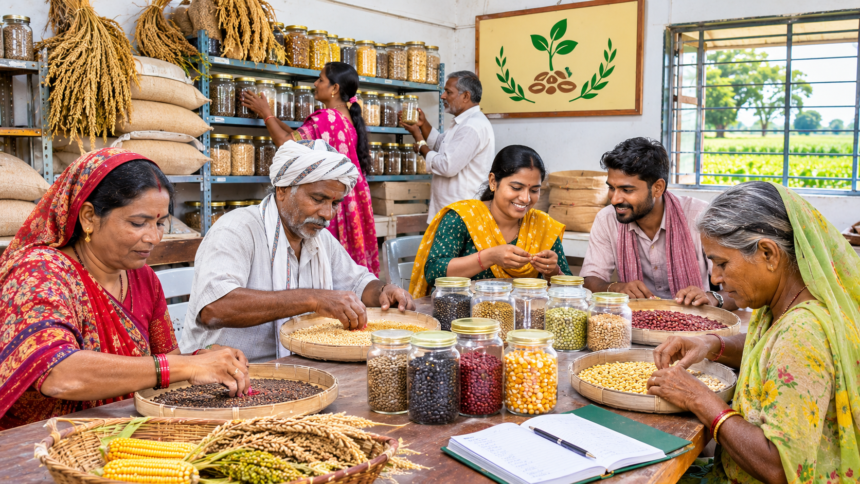
India is taking another step towards strengthening its agricultural sector through community-managed seed banks. A new initiative under the DIVERSIFARM-India project has mapped 652 Community Seed Banks (CSBs) across the country and introduced a capacity-building manual to improve their management and long-term sustainability.
The development was highlighted as efforts continue to support small farmers, preserve traditional crop varieties and improve food security.
652 Community Seed Banks Identified Across India
The mapping exercise aims to identify community-level seed banks and understand how they support farmers in different regions.
These institutions help local farming communities conserve, store and exchange traditional seeds suited to their agricultural conditions.
New Manual to Improve Seed Bank Management
A new capacity-building manual and toolkit have been introduced to help community seed banks improve their operations.
The resources focus on better seed conservation, management practices, knowledge sharing and stronger institutional support.
Benefits for Small and Rural Farmers
Community seed banks can help farmers maintain access to locally adapted crop varieties and reduce dependence on a limited range of commercial seeds.
They also support agricultural biodiversity and help preserve traditional farming knowledge, particularly in rural communities.
Focus on Sustainable Agriculture
The DIVERSIFARM-India initiative is working to strengthen existing community seed banks rather than simply establish new ones.
The programme is expected to support collaboration among farmers, researchers and agricultural organisations while identifying opportunities to expand successful models.
The development highlights the growing importance of community-led seed conservation in India’s agricultural future.