
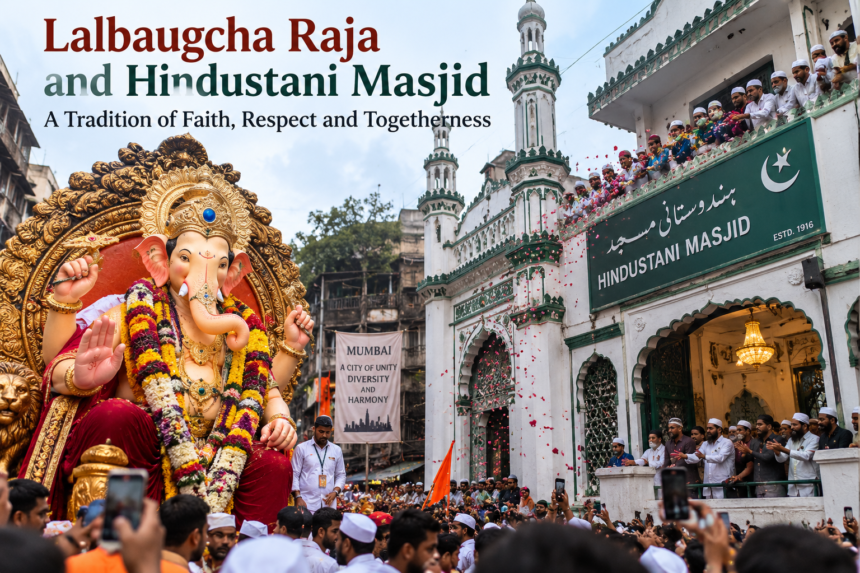
Every year, Mumbai’s famous Lalbaugcha Raja attracts thousands of devotees during the Ganpati festival. Among the many memorable moments of the idol’s grand Visarjan procession, one particular stop has drawn attention over the years. As the procession moves through Byculla on its way to Girgaon Chowpatty, Lalbaugcha Raja pauses for a few minutes in front of Hindustani Masjid. During this brief halt, flowers are showered and sweets are distributed, creating a notable moment during the lengthy procession.
Why Does Lalbaugcha Raja Stop at Hindustani Masjid?
The short halt in front of Hindustani Masjid is regarded as a symbol of communal harmony and Mumbai’s diverse social fabric. According to the account behind the tradition, the practice dates back to the 1980s, when members of the local Muslim community began assisting the Lalbaugcha Raja Sarvajanik Ganeshotsav Mandal during the procession.
The route from Lalbaug to Girgaon Chowpatty passes through the busy and narrow streets of Byculla, where managing the massive idol and large crowds can be challenging. Local Muslims are said to have helped by providing water, making room for the procession and assisting with crowd management. In appreciation of their support, the Mandal began stopping the idol in front of the mosque as a gesture of gratitude.
What began as an expression of appreciation eventually became an annual part of the Visarjan procession. The tradition has continued over the years, including during periods when the city experienced communal tensions, and has come to represent the relationship between the communities in the area.
History of Lalbaugcha Raja Since 1934
The Lalbaugcha Raja Sarvajanik Ganeshotsav Mandal was established in 1934 at Lalbaug Market by members of the Koli community. The Mandal came into existence during a significant period of India’s freedom struggle and has since become an important part of Mumbai’s Ganesh Chaturthi celebrations.
Over the decades, Lalbaugcha Raja has appeared in different forms and themes. These representations have drawn inspiration from Hindu mythology, Indian history and current affairs, while the devotion of Mumbaikars towards the iconic Ganpati has remained unchanged.
In 2000, the distinctive face of Lalbaugcha Raja was finalised and patented. The same iconic appearance has continued to be associated with the idol ever since.
The Grand Lalbaugcha Raja Visarjan Procession
The massive Ganpati festival is organised with the help of 35 organisers and more than 1,200 volunteers. Their efforts are particularly important during the final Visarjan procession, when large crowds accompany Lalbaugcha Raja towards Girgaon Chowpatty.
The journey to the immersion point can continue for more than 22 hours, making it one of the most significant events of Mumbai’s Ganpati celebrations. Amid the crowds, music and celebrations, the brief stop outside Hindustani Masjid remains a distinctive part of the procession and is remembered as a gesture of gratitude and community harmony.