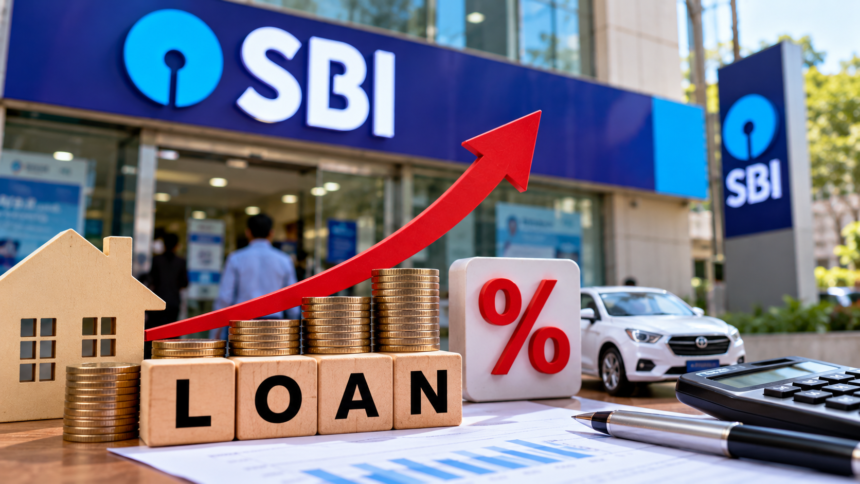
The State Bank of India (SBI), the country’s largest public sector bank, has increased its Marginal Cost of Funds Based Lending Rate (MCLR) by 15 basis points, or 0.15 percentage points, for selected loan tenures. The revision may increase borrowing costs for customers whose floating-rate loans are linked to the affected MCLR rates.
According to the revised rate structure, the overnight and one-month MCLR rates remain unchanged, while rates for the three-month, six-month, one-year, two-year and three-year tenures have increased by 0.15 percentage points. Many retail loans, including certain home and car loans, are linked to the one-year MCLR.
Which SBI Loan Customers Will Be Affected?
The impact of the MCLR increase will depend on the benchmark linked to a borrower’s loan and the applicable interest-rate reset date.
Customers with MCLR-linked floating-rate loans may face higher interest rates when their loans are due for a reset. However, the change may not affect every borrower immediately because loan agreements generally specify when interest rates are reviewed.
Borrowers whose loans are linked to external benchmarks, such as the External Benchmark Linked Rate (EBLR) or Repo Linked Lending Rate (RLLR), will not be directly affected by this particular MCLR revision.
Customers facing a higher EMI can consider continuing with the revised monthly payment or discussing an extension of the loan tenure with the bank, subject to its terms. Extending the repayment period may reduce the monthly instalment but can increase the total interest paid over the life of the loan.
SBI Chairman Says Deposit Rates May Remain Stable
SBI Chairman C.S. Setty has said that deposit rates are unlikely to rise over the next two to three months because the banking system currently has surplus liquidity.
Speaking a day after the Reserve Bank of India’s policy announcement, Setty also said that the central bank’s move towards tighter rates could help banks improve their net interest margins (NIMs) over the following three quarters.
However, he indicated that the situation could change if credit growth remains strong. Banks may then consider increasing deposit rates to attract additional funds to support lending.
Setty also acknowledged the importance of providing depositors with positive real returns, meaning interest earnings that account for inflation.
SBI Expects Credit Growth of 14–15%
SBI expects to maintain loan book growth of around 14–15%, according to Setty. He explained that the bank considers credit growth of at least two to three percentage points above nominal GDP growth desirable.
With nominal GDP growth estimated at 12%, SBI believes that credit growth in the 14–15% range would help sustain the momentum of economic activity.
The bank’s outlook on lending and deposit rates will depend on liquidity conditions, credit demand and developments in the broader banking sector.
Disclaimer: This article is intended for general informational purposes only and does not constitute financial advice. Loan interest rates, EMI changes and deposit rates depend on the bank’s current terms and the conditions of individual accounts. Borrowers should check SBI’s official announcements and their loan agreements or contact the bank to confirm how the revised MCLR affects their repayments.