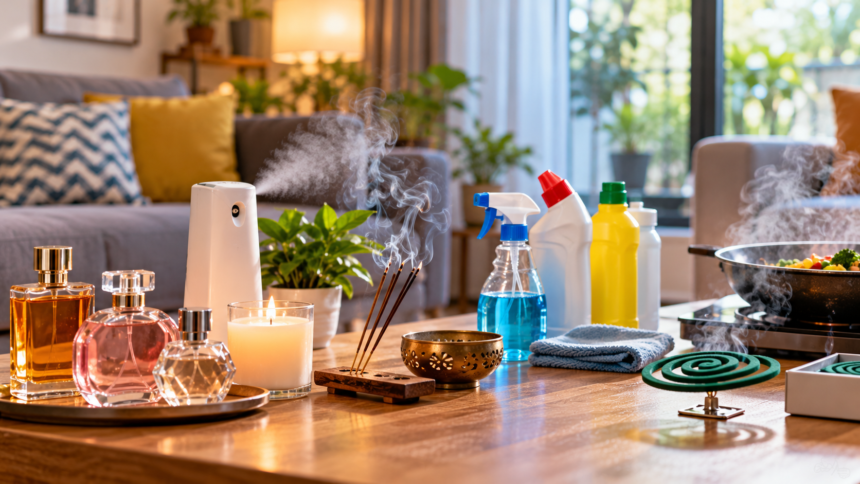
Your home may smell fresh, but that does not necessarily mean the indoor air is clean. Everyday products and household activities can release gases, smoke and fine particles that may irritate the nose, throat and lungs.
For people with asthma, allergies or other respiratory conditions, these irritants can sometimes trigger coughing, wheezing and breathing discomfort. Pulmonologists Dr Swapneel Mehta and Dr Susheel Bindroo, quoted in the original report, highlighted several common sources worth paying attention to.
1. Perfumes and Fragranced Products
Perfumes, deodorants, scented candles and other fragranced products can release volatile organic compounds (VOCs) into indoor air. Some people are sensitive to these substances and may experience throat irritation, coughing, headaches or breathing discomfort.
Strong fragrances can be particularly troublesome for people with asthma or sensitive airways. If symptoms repeatedly occur around a particular scent, reducing exposure may help.
2. Air Fresheners and Room Sprays
Room sprays, plug-in fresheners and scented gels can release fragrance chemicals into the surrounding air. While they may mask unpleasant smells, they do not necessarily remove the source of the odour or improve air quality.
Frequent use in enclosed rooms may increase exposure to airborne irritants. Rather than repeatedly covering up a smell, identify its source and improve ventilation where possible.
3. Household Cleaning Products
Bleach, disinfectants, toilet cleaners and other strong cleaning products can release fumes that irritate the eyes, nose, throat and respiratory tract, particularly in small or poorly ventilated spaces.
Open windows or use an exhaust fan when appropriate, follow the product label and never mix cleaning chemicals unless the label explicitly permits it. In particular, mixing bleach with acidic cleaners or ammonia can produce dangerous gases.
4. Incense, Dhoop and Mosquito Coils
Incense sticks, dhoop and mosquito coils are commonly used in Indian homes, but burning them produces smoke and fine particles. These pollutants can accumulate indoors, especially when doors and windows remain closed.
Repeated exposure may aggravate respiratory symptoms in sensitive individuals. Limiting indoor burning and ensuring adequate ventilation can help reduce exposure.
5. Cooking Fumes
Frying, grilling and cooking at high temperatures can release fine particles and gases into the kitchen. Gas stoves can also contribute nitrogen dioxide to indoor air.
Using a kitchen exhaust that vents outdoors, when available, can help remove some cooking-related pollutants. Ventilation is particularly important during prolonged cooking or when smoke builds up.
6. Mosquito Repellents and Coils
Mosquito coils release smoke and airborne particles while burning. Using them for long periods in a closed bedroom may increase exposure to respiratory irritants.
Consider mosquito-control methods that do not require continuous indoor burning, and follow all product safety instructions. Keep indoor spaces adequately ventilated whenever possible.
How to Improve Indoor Air Quality
A few practical steps can help reduce exposure to common household irritants:
- Reduce the use of strong fragrances and unnecessary room sprays.
- Ventilate rooms while cleaning and cooking, where outdoor air conditions allow.
- Use a kitchen exhaust that vents outdoors.
- Limit smoke-producing products indoors, especially in enclosed rooms.
- Follow product labels and never mix cleaning chemicals.
- Notice whether particular products consistently trigger symptoms and avoid them when possible.
Persistent coughing, wheezing or breathing discomfort should not automatically be attributed to household irritants. Seek medical advice if symptoms continue, and obtain urgent medical help for severe or sudden breathing difficulty.