

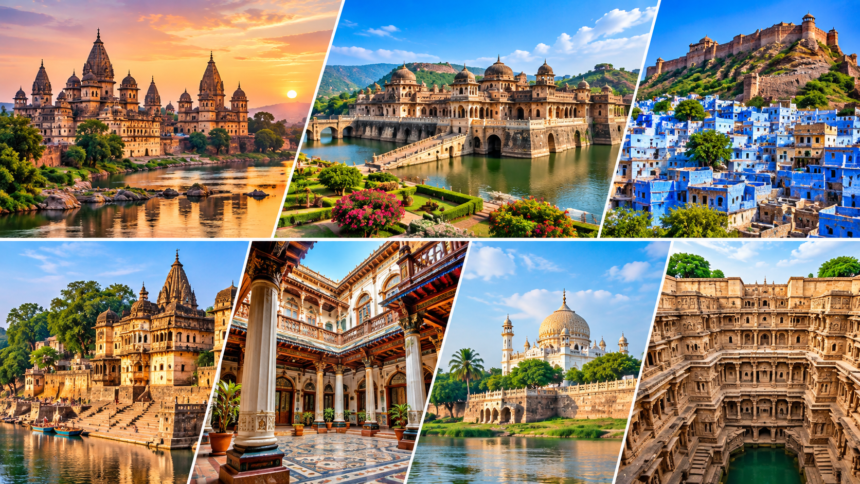
India’s heritage extends far beyond its most famous forts, palaces and monuments. Across the country, smaller towns preserve fascinating pieces of history through ancient temples, royal residences, traditional homes, old markets and historic streets. For travellers who prefer slower journeys and culturally rich destinations, these seven heritage towns offer plenty to explore.
Orchha, Madhya Pradesh
Located on the banks of the Betwa River, Orchha retains the character of a historic town shaped by the Bundela Rajput rulers. Founded in the 16th century, the town is known for its impressive palaces, temples and royal cenotaphs.
The Orchha Fort complex remains one of its major attractions, with the Jahangir Mahal and Raj Mahal displaying detailed architectural work. Another important landmark is the Ram Raja Temple, where Lord Ram is worshipped in the form of a king.
Mandu, Madhya Pradesh
Set on a plateau amid the Vindhya ranges, Mandu brings together historic architecture and striking natural surroundings. The medieval city developed under the Malwa rulers and features numerous monuments dating from the 15th and 16th centuries.
Jahaz Mahal is among its most recognisable structures, appearing to stand between two lakes, while Hindola Mahal is known for its distinctive sloping walls. Mandu is also linked with the well-known tale of Sultan Baz Bahadur and Rani Roopmati.
Bundi, Rajasthan
Away from the more frequently visited cities of Jaipur, Jodhpur and Udaipur, Bundi provides a quieter look at Rajasthan’s heritage. Its narrow lanes, blue-painted houses and historic structures give the town a distinctive character.
The hilltop Taragarh Fort and Bundi Palace are among its key attractions. The palace is particularly known for its colourful murals featuring royal life, mythology and scenes from nature. Bundi is also home to several historic stepwells, which were traditionally constructed for water storage and to provide relief from the region’s heat.
Maheshwar, Madhya Pradesh
Situated beside the Narmada River, Maheshwar is known for its combination of religious heritage, architecture and traditional textiles. The town developed around Maheshwar Fort, which is closely associated with the 18th-century ruler Ahilyabai Holkar.
Overlooking the Narmada and its ghats, the fort provides views of temples and stone steps leading towards the river. Maheshwar is also renowned for its handwoven Maheshwari sarees, giving visitors an opportunity to experience the region’s textile traditions alongside its historical sites.
Chettinad, Tamil Nadu
Chettinad stands apart from traditional fort towns with its distinctive architectural heritage. The region is famous for its grand mansions built by the Nattukottai Chettiar community, especially during the 19th and early 20th centuries.
These large homes showcase a combination of local craftsmanship and European and Southeast Asian influences. Ornate courtyards, carved wooden elements, colourful tiles and elaborate columns are common features. Chettinad is also celebrated for its distinctive cuisine, making the region an interesting destination for those looking to combine history, architecture and food.
Srirangapatna, Karnataka
Located near Mysuru, Srirangapatna was once the capital of the Kingdom of Mysore under Tipu Sultan. Situated on an island in the Cauvery River, the town is home to several important historical landmarks.
Among them are the Ranganathaswamy Temple, Tipu Sultan’s summer palace and the Gumbaz. The Gumbaz is the burial place of Tipu Sultan, his father Hyder Ali and his mother Fakhr-un-Nisa. Its historic sites offer visitors an insight into the political and military history of southern India, while the surrounding river landscape adds to the experience.
Patan, Gujarat
Patan is known for both its architectural heritage and long-standing textile traditions. The town’s most famous attraction is Rani ki Vav, an intricately designed stepwell dating back to the 11th century. Its multiple levels feature hundreds of sculptures and detailed ornamental work.
Patan is also closely associated with Patan Patola, a highly skilled double-ikat weaving tradition. Exploring the craftsmanship behind these textiles adds another cultural dimension to a visit, making Patan a destination where historic architecture and traditional art come together.