

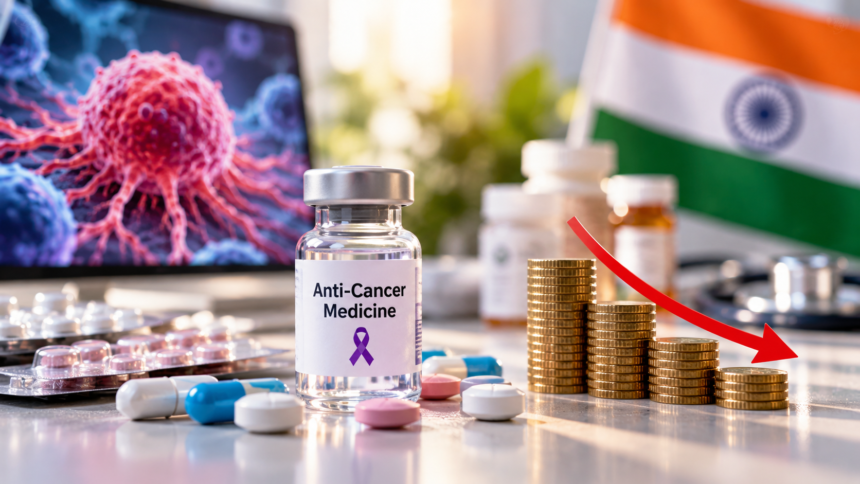
The Indian government has decided to limit trade margins on all non-scheduled anti-cancer medicines to 30% of their maximum retail price (MRP), in a move aimed at making cancer treatment more affordable. Official sources confirmed the decision on Thursday, October 8, 2026, according to a report by the IANS news agency.
The proposed measure will cover branded and generic medicines, domestically manufactured and imported products, as well as patented and non-patented drugs. Expected to take effect later in October, the policy could affect around 110 anti-cancer medicines, including 35 patented drugs. Officials estimate that the MRP of some affected medicines could fall by as much as 70%.
The initiative aims to address high mark-ups across the pharmaceutical distribution chain and reduce the financial burden on patients who require costly cancer treatment.
Around 110 Cancer Medicines Could Become Cheaper
According to official estimates, approximately 110 anti-cancer medicines will come under the new pricing measure. The list includes 35 patented drugs, bringing a range of treatments within the expanded policy.
The government aims to reduce differences in trade margins and make essential cancer medicines more accessible without affecting their availability in the market. The expected price reductions could help patients manage treatment expenses, particularly when medication is required over an extended period.
However, the estimated reduction of up to 70% does not mean that every medicine covered by the policy will become cheaper by the same amount. The actual change will depend on the medicine and its existing pricing structure.
Trade Margins Limited to 30% of MRP
Under the proposed framework, the trade margin on every non-scheduled anti-cancer medicine will be restricted to 30% of its MRP. The rule will apply regardless of whether a product is branded or generic, imported or manufactured in India, or patented or non-patented.
The government expects the measure to reduce out-of-pocket spending for cancer patients, many of whom face substantial medical expenses during treatment.
Official estimates suggest that the policy could generate annual savings of approximately ₹2,500 crore for patients. The intended benefit is to bring down retail prices by limiting the margins earned throughout the medicine supply chain.
Policy Expands on the 2019 Pricing Intervention
The latest decision builds on a similar government initiative introduced in 2019, when trade margins on selected anti-cancer medicines were capped to address excessive pricing.
The new framework significantly broadens the scope of that earlier measure by extending the margin limit to all non-scheduled anti-cancer medicines rather than only selected products.
The expanded coverage is intended to bring more cancer treatments within the pricing framework and improve affordability for patients. The policy is expected to come into force later in October 2026.
Disclaimer: This article is based on information attributed to official sources and reported by IANS. Price reductions and estimated patient savings are projections and may vary depending on individual medicines and their pricing. Readers should refer to official government notifications for the final implementation details.