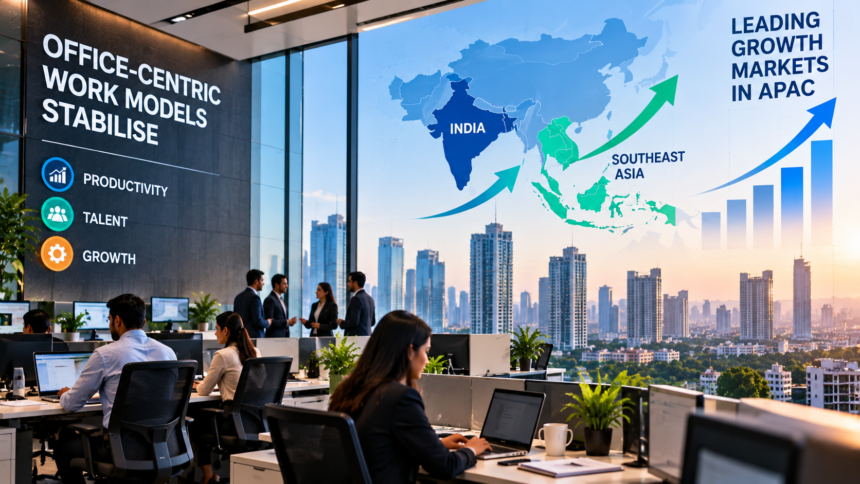
India and Southeast Asia are emerging as key growth markets for office real estate across the Asia-Pacific (APAC) region, as companies focus on business expansion, talent acquisition and better workplace facilities. A new report by Colliers indicates that office-based working arrangements have become the preferred model for most organisations across the region.
The findings highlight a shift towards workplace strategies that prioritise productivity, collaboration and long-term business performance, while companies continue to manage costs and prepare for changing workforce needs.
Office-Centric Workplaces Become the Standard
According to the 2027 Colliers Asia Pacific Workplace Insights report, 82% of surveyed organisations across the region now follow office-centric working models. Meanwhile, 80% of occupiers expect no significant changes to their existing workplace policies over the next 12 months.
The findings suggest that companies are moving towards greater stability in their workplace arrangements, with offices continuing to play a central role in daily operations.
India and Southeast Asia Focus on Expansion
Businesses in India and Southeast Asia remain focused on growth despite wider geopolitical uncertainties. Around 34% of organisations in the region are actively pursuing expansion, with cost efficiency and access to skilled talent among their main considerations.
Arpit Mehrotra, Managing Director of Office Services at Colliers India, said India’s office market continued to benefit from economic resilience and sustained demand from businesses.
He noted that companies increasingly view offices as strategic assets that can support performance, attract talent and encourage collaboration. According to the survey, 21% of occupiers in India and Southeast Asia are prioritising upgrades to higher-quality office spaces, while an equal proportion are looking to reconfigure their existing workplaces.
AI Is Changing Office Space Requirements
The report also challenges the assumption that artificial intelligence will automatically lead companies to reduce their office space.
All surveyed respondents indicated that AI is creating specialised roles requiring distinct technical skills and changes in collaborative working arrangements. In addition, 47% of occupiers expect AI to generate demand for different types of office spaces and workplace formats, particularly technology-enabled environments.
These developments are encouraging businesses to invest in offices that better support evolving work patterns, innovation and long-term growth.
Companies Optimise Space to Manage Costs
Occupancy costs remain a major concern, with 75% of respondents identifying them as an important factor in their operational decisions.
However, many companies are choosing to optimise their existing property portfolios rather than reduce their overall office footprint. Around 40% of respondents plan to renew their current leases, while another 29% intend to maintain their existing office space without reductions.
Mike Davis, Managing Director of Occupier Services for Asia Pacific at Colliers, said workplace strategies are increasingly focused on how offices contribute to productivity, collaboration, innovation and business performance.
He added that organisations are placing greater emphasis on measurable outcomes by aligning workplace design, technology and talent strategies with their business objectives.