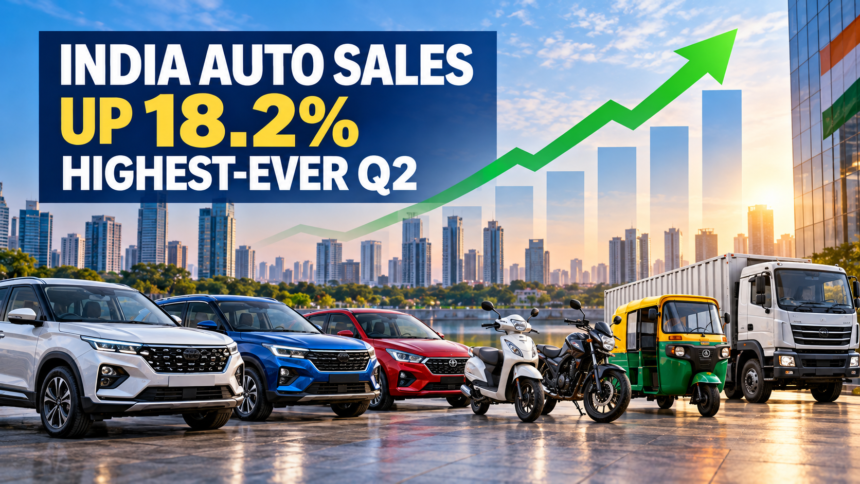
India’s automobile industry recorded its strongest-ever second-quarter sales in July–September 2026, with domestic sales across major vehicle categories rising 18.2% year-on-year to 83.88 lakh units. According to the Society of Indian Automobile Manufacturers (SIAM), passenger vehicles, two-wheelers, three-wheelers and commercial vehicles all achieved record sales for the quarter.
The strong performance reflects improved affordability, steady demand across rural and urban markets, infrastructure development and a gradual replacement cycle for vehicles.
Passenger Vehicles and Two-Wheelers Drive Sales Growth
Passenger vehicle sales increased 30.7% to 13.61 lakh units in the second quarter of FY2026–27. Two-wheeler sales rose 15.2% to 64.33 lakh units, while three-wheeler sales grew 23.6% to 2.85 lakh units.
Commercial vehicle sales also recorded strong growth, climbing 28.7% to 3.09 lakh units.
SIAM Director General Rajesh Menon said all four major vehicle segments registered their highest-ever second-quarter sales during the period.
Within the passenger vehicle category, utility vehicles continued to account for the largest share, representing 68% of sales. Utility vehicle sales increased 34.2% year-on-year, while passenger car sales grew 24.9%.
Scooters led growth in the two-wheeler segment, with sales rising 27.7%. Motorcycle sales recorded a more moderate increase of 7.4%.
Improved Affordability and Demand Support Growth
SIAM attributed the industry’s performance to several factors, including improved affordability following GST 2.0, resilient demand in rural and urban areas, healthy freight movement and infrastructure-led economic activity.
The gradual replacement of older vehicles also contributed to sales momentum across categories.
Vehicle Exports Record Mixed Performance
Exports increased across several vehicle segments during the quarter. Two-wheeler exports climbed 27.7% to 16.5 lakh units, marking their highest-ever second-quarter level.
Three-wheeler exports rose 30.4% to 1.6 lakh units, while commercial vehicle exports surged 72.5% to more than 41,000 units.
Passenger vehicle exports moved in the opposite direction, declining 5.2% to 2.29 lakh units. SIAM attributed the fall mainly to a higher comparison base and logistical challenges associated with the West Asia crisis.
Auto Industry Outlook for the Second Half of FY27
SIAM expects the automobile industry to maintain positive growth during the second half of FY2026–27. The festive season, new vehicle launches, infrastructure spending, fleet replacement and demand for last-mile mobility are expected to support activity.
However, the industry remains cautious about potential challenges, including higher inflation, possible interest rate increases and geopolitical uncertainty. Growth could also moderate as sales are compared with a higher base.
SIAM President Shenu Agarwal said the industry was looking forward to sustained momentum during the festive season while remaining cautiously optimistic amid continuing global economic uncertainties.