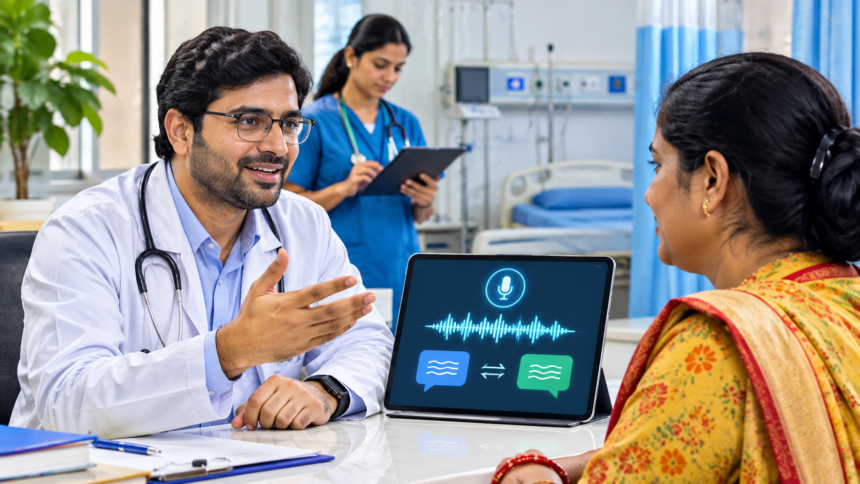
Artificial intelligence is taking a significant step towards transforming healthcare in India, with new multilingual technology being demonstrated to make communication between doctors and patients easier. The initiative aims to help medical professionals understand patients who speak different Indian languages while reducing the time spent on paperwork and clinical documentation.
The technology was showcased at the Global Digital Health Summit 2026, held in New Delhi . Leading medical institutions, including AIIMS and JIPMER, demonstrated how voice-based AI tools can support everyday hospital operations.
Doctors Can Record Medical Notes Using Their Voice
One of the major applications involves converting doctors’ spoken words into written medical records. At JIPMER, the technology has been integrated with its hospital management system to help doctors prepare patient histories, inpatient notes and discharge instructions through voice-based documentation.
A similar facility at AIIMS allows doctors to dictate prescriptions instead of typing them manually. The system has already received positive feedback during pilot use in the Neurology and Neurosurgery departments and is now being expanded across the institute.
AI Can Help Doctors and Patients Understand Different Languages
Another important application is helping doctors communicate with patients who speak different languages.
The technology supports speech recognition, translation and voice-based communication, allowing medical information to be understood across language barriers. This could be particularly useful in hospitals where patients travel from different states for treatment.
The system also aims to make patients more comfortable by allowing them to communicate their health concerns in a language they understand.
Technology Supports 36 Indian Languages
The multilingual platform currently supports 36 Indian text languages and 23 Indian voice languages, along with 35 international languages.
Its tools include speech-to-text conversion, text-to-speech technology, translation and transliteration. These features can help healthcare professionals manage documentation more efficiently while improving access to medical information.
A New Direction for Digital Healthcare in India
The demonstrations highlight how artificial intelligence could make healthcare services more accessible, especially for people who face language difficulties while visiting hospitals.
By reducing documentation work and supporting multilingual communication, the technology has the potential to improve hospital efficiency and patient experience.
However, AI is intended to assist healthcare professionals rather than replace medical judgement. Doctors will continue to remain responsible for diagnosis, treatment decisions and patient care.