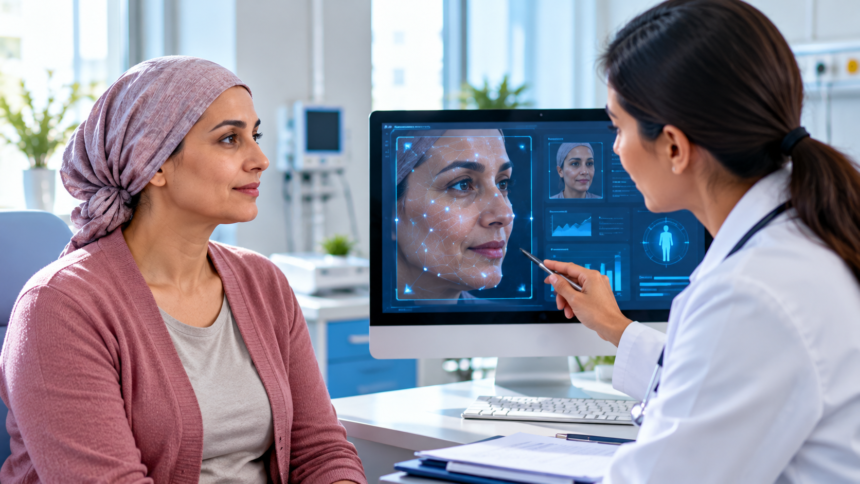
Researchers have developed a new artificial intelligence (AI) system that may help doctors assess survival outcomes among people diagnosed with cancer by analysing facial photographs. The technology could eventually provide additional information to support medical assessments, although further testing is needed before it can be used in routine healthcare.
How the New AI Technology Works
The system, called FAHR-FaceSurvival, was developed by researchers at Mass General Brigham. It builds on earlier technology designed to estimate a person’s biological age from a photograph.
The research used facial images and medical outcome data from more than 30,000 cancer patients, drawing on a broader foundation model trained using over 40 million facial photographs. The researchers examined whether patterns in these images could help predict patients’ survival outcomes.
What the Researchers Discovered
The study, published in The Lancet Digital Health, found that patients with higher scores from the AI system generally had shorter survival times than those with lower scores.
Among patients in the highest 10% of scores, around half died within 90 days, compared with approximately 2% among those in the lowest 10%. These figures describe the groups studied and should not be interpreted as an individual prediction for any patient.
Researchers also explored which facial regions influenced the model’s predictions. However, they have not yet established precisely which physical or health-related signals the AI detects.
Why Further Research Is Important
The technology could potentially give doctors another source of information when evaluating patients and considering treatment options. However, predicting an outcome from a photograph does not automatically mean that using the prediction will improve medical care.
Experts have highlighted the need to test whether the system adds useful information beyond existing clinical assessments. Researchers must also examine potential bias, since facial-image models could produce unreliable results for some populations.
What This Means for Patients
The findings represent an early research development rather than an established medical test. The system requires broader validation and further clinical studies before doctors can determine whether it is safe and useful in everyday practice.
Patients should not use facial appearance or online AI tools to estimate their cancer prognosis. Individual outcomes depend on many medical factors and should be discussed with a qualified healthcare professional.