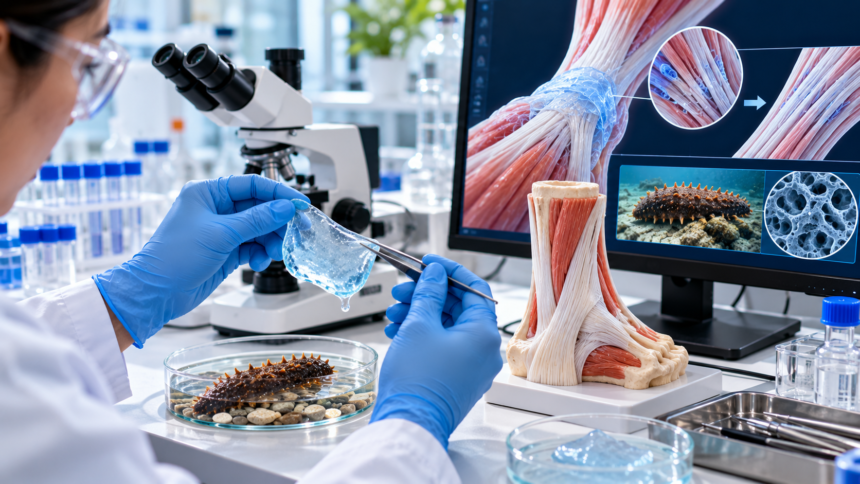
A new gel inspired by sea cucumbers could one day help repair damaged tendons and other soft tissues. Developed by researchers at the University of Waterloo and collaborators, the material is designed to support tissue as it heals before gradually breaking down and being absorbed by the body.
The findings offer a potential new direction for regenerative medicine, although the material has so far been tested in animals rather than people.
How the Bio-Inspired Gel Works
Sea cucumbers can change the stiffness of their body tissues. Researchers used this natural ability as inspiration for creating a hydrogel whose firmness can be adjusted for different medical applications.
The water-rich material acts as a temporary scaffold, providing support while new tissue develops. Researchers can change its mechanical properties by freezing the material and then soaking it in specially prepared salt solutions.
This flexibility could be important because different tissues require different levels of support. A tendon, for example, needs a different mechanical environment from softer tissues.
Promising Results in Tendon Repair
In a preclinical experiment involving rats with damaged tendons, researchers compared repairs using the gel with repairs made using stitches alone.
The tendons treated with the hydrogel showed improved healing and the growth of more organised new tissue. Researchers also reported that the repaired tendons had function comparable to healthy tendons.
As healing progressed, the gel gradually broke down and was absorbed by the body over approximately eight weeks. This suggests that the material may provide temporary support without remaining permanently in the repaired area.
Could It Help Repair Other Tissues?
Researchers believe the adjustable material could eventually be explored for repairing muscles, cartilage, skin and other soft tissues. However, these possible applications have not yet been established through clinical testing.
The ability to customise the gel’s stiffness could help scientists design materials for different parts of the body. Further experiments will be needed to determine which applications are practical and safe.
What Happens Next?
The researchers plan to continue testing the material in larger animals before considering clinical trials in humans. The team has also applied for patents related to the technology and is exploring ways to develop it further.
The findings are encouraging, but the gel is not an approved treatment for tendon injuries. Results from animal studies do not necessarily translate into the same benefits for people.
For now, the research represents an early step towards developing temporary, adaptable materials that could support tissue repair in future medical treatments.