

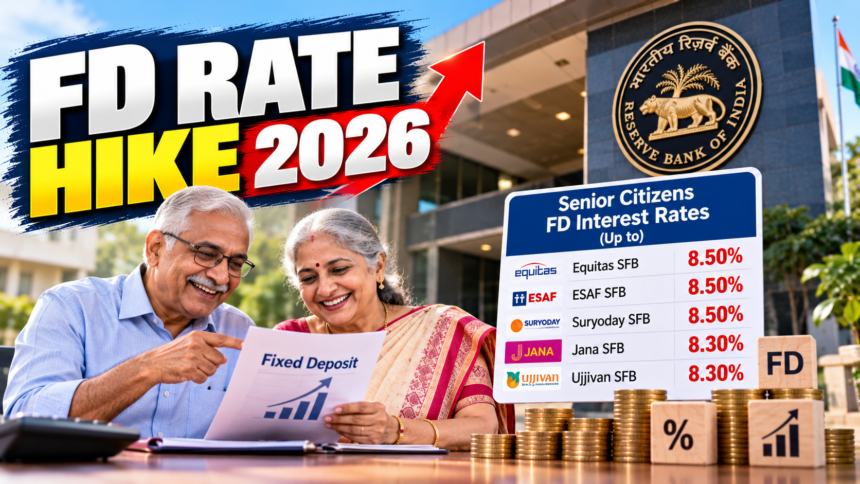
The Reserve Bank of India (RBI) raised its repo rate by 25 basis points, taking it from 5.25% to 5.50% at its Monetary Policy Committee meeting on October 7, 2026. Following the decision, banks may review their fixed deposit (FD) interest rates, potentially improving returns for people opening new deposits or renewing existing ones.
However, banks do not necessarily revise FD rates immediately after an RBI policy announcement. The timing depends on factors such as their funding requirements and liquidity position. Some lenders may announce changes within days, while others could take several weeks.
Senior citizens looking to invest in fixed deposits should compare rates across banks and check the interest available for their preferred tenure. The highest advertised rate may apply only to a specific deposit period, so checking the terms is important before investing.
Senior Citizen FD Interest Rates: Bank-Wise List for 2026
Several small finance banks are offering senior citizens interest rates of up to 8.50%, according to the rates provided below. The maximum rates vary by bank and deposit tenure. <Cite refs={[“turn807033search0″,”turn807033search1”]}/>
Small Finance Banks
| Bank | Highest FD rate |
|---|---|
| Equitas Small Finance Bank | Up to 8.50% |
| ESAF Small Finance Bank | Up to 8.50% |
| Suryoday Small Finance Bank | Up to 8.50% |
| Jana Small Finance Bank | Up to 8.30% |
| Ujjivan Small Finance Bank | Up to 8.30% |
| Shivalik Small Finance Bank | Up to 8.25% |
| Utkarsh Small Finance Bank | Up to 8.25% |
| AU Small Finance Bank | Up to 7.90% |
| Slice Small Finance Bank | Up to 7.75% |
Private Sector and Other Banks
| Bank | Highest FD rate |
|---|---|
| DCB Bank | Up to 8.00% |
| Bandhan Bank | Up to 7.95% |
| SBM Bank India | Up to 7.80% |
| Axis Bank | Up to 7.25% |
| Kotak Mahindra Bank | Up to 7.15% |
| HDFC Bank | Up to 7.10% |
| ICICI Bank | Up to 7.10% |
| IDBI Bank | Up to 7.05% |
Public Sector Banks
| Bank | Highest FD rate |
|---|---|
| Bank of India | Up to 7.45% |
| Bank of Baroda | Up to 7.25% |
| Indian Overseas Bank | Up to 7.10% |
| Punjab National Bank | Up to 7.10% |
| State Bank of India (SBI) | Up to 7.05% |
| Union Bank of India | Up to 7.05% |
Foreign Banks
| Bank | Highest FD rate |
|---|---|
| Standard Chartered Bank | Up to 7.10% |
| Deutsche Bank | Up to 7.00% |
| HSBC Bank | Up to 6.00% |
These figures represent the maximum rates supplied for the article, not rates available for every tenure. Actual returns depend on the bank’s current rate card, deposit duration, amount and applicable senior-citizen benefits. Check the latest terms directly with the bank before booking an FD.
₹10 Lakh FD Calculation: How Much Can You Earn in 3 Years?
The return on a fixed deposit depends on the interest rate and the way interest is compounded. Based on annual compounding, the estimated returns on a ₹10 lakh deposit over three years are as follows.
| Annual interest rate | Interest earned | Maturity amount |
|---|---|---|
| 8.50% | ₹2,77,289 | ₹12,77,289 |
| 8.00% | ₹2,59,712 | ₹12,59,712 |
| 7.50% | ₹2,42,297 | ₹12,42,297 |
At an annual interest rate of 8.50%, a ₹10 lakh FD would generate approximately ₹2.77 lakh in interest over three years. At 8%, the estimated interest would be around ₹2.60 lakh, while a 7.50% rate would produce approximately ₹2.42 lakh.
These calculations are illustrative and assume annual compounding without withdrawals or other adjustments.
₹10 Lakh FD for 5 Years: Interest and Maturity Amount
Keeping money invested for five years allows interest to accumulate over a longer period. Using the same annual-compounding method, the estimated returns are:
| Annual interest rate | Interest earned | Maturity amount |
|---|---|---|
| 8.50% | ₹5,03,656 | ₹15,03,656 |
| 8.00% | ₹4,69,328 | ₹14,69,328 |
| 7.50% | ₹4,35,629 | ₹14,35,629 |
At 8.50%, a ₹10 lakh investment would grow to approximately ₹15.04 lakh after five years. At 8%, the maturity amount would be about ₹14.69 lakh, while a 7.50% rate would result in approximately ₹14.36 lakh.
The figures are estimates before tax and assume annual compounding. Actual FD maturity values may differ depending on the bank’s compounding method, payment terms and applicable conditions.
Disclaimer
This article is for general informational purposes and does not constitute financial or investment advice. FD interest rates can change at any time and may differ by tenure, deposit amount and customer category. The returns shown are illustrative calculations based on annual compounding and do not account for tax or other deductions. Check the bank’s official rate card and deposit terms before investing, and consider your financial goals and liquidity requirements when choosing an FD.