

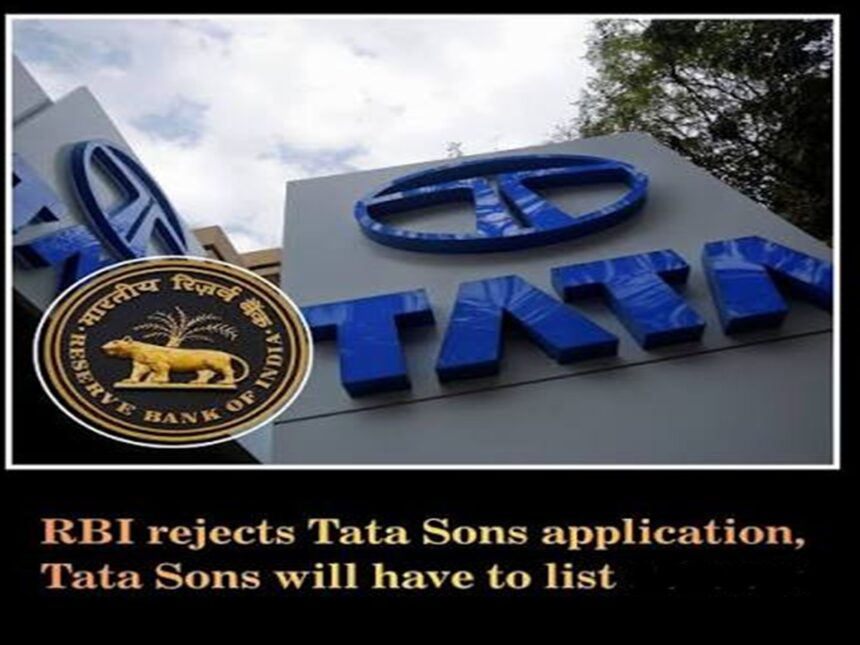
The Reserve Bank of India (RBI) has rejected Tata Sons’ request to surrender its registration as a core investment company, effectively shutting down the holding company’s attempt to avoid mandatory stock-market listing as an Upper Layer non-banking financial company (NBFC).
According to sources, the decision was communicated to Tata Sons’ company secretary and chief financial officer on Saturday. The company had submitted its application in March 2024, seeking to exit the NBFC framework.
With the RBI turning down the request, Tata Sons will remain classified as an Upper Layer NBFC, bringing it under stricter regulatory requirements, including the requirement to list its shares. The central bank had placed Tata Sons in the Upper Layer category in September 2022 and had initially provided such entities a three-year window to comply with the listing requirement.
Tata Sons Had Sought to Exit NBFC Rules
Tata Sons had been attempting to move outside the RBI’s NBFC regulatory framework before the original September 30, 2025 deadline.
As part of its strategy, the holding company repaid more than ₹21,000 crore in debt during 2024 before applying to surrender its registration. If approved, the move would have enabled Tata Sons to continue operating as a privately held holding company without the additional obligations applicable to Upper Layer NBFCs.
However, the RBI kept the application under consideration through 2025 while continuing to include Tata Sons in its list of Upper Layer NBFCs.
The latest rejection effectively removes that route.
Why Tata Sons Is Classified as an Upper Layer NBFC
The RBI introduced a scale-based regulatory framework for NBFCs in October 2021. Under the system, NBFCs are divided into four categories—Base, Middle, Upper and Top Layer—with regulatory oversight increasing at each level.
Tata Sons was moved into the Upper Layer in September 2022, alongside major financial companies such as Bajaj Finance and Shriram Finance.
The regulatory framework was subsequently revised in June 2026. Under the updated rules, NBFCs with assets of ₹1 lakh crore or more fall within the Upper Layer category. Tata Sons reportedly had standalone assets exceeding ₹2 lakh crore as of March 2026, keeping it firmly within the scope of the enhanced regulatory regime.
What a Tata Sons Listing Could Mean
A stock-market listing would represent a major change for Tata Sons, the principal holding company of the Tata Group.
The company has investments across several major sectors, including technology, automobiles, steel, consumer businesses, aviation, hospitality and financial services.
Going public would bring greater transparency to Tata Sons, requiring regular disclosures about its financial performance, investments and capital allocation. It could also provide investors with greater visibility into the value of the group’s extensive portfolio of companies.
However, the RBI’s decision does not mean that Tata Sons has announced an initial public offering (IPO).
The size, structure and timing of any potential listing have not yet been finalised.
Tata Sons Shareholders Divided Over Listing
The question of a Tata Sons listing has also highlighted differences among its key shareholders.
Tata Trusts, which is chaired by Noel Tata and owns more than 65% of Tata Sons, has opposed the prospect of a public listing. On the other hand, the Shapoorji Pallonji Group, which holds an approximately 18% stake, has supported a listing, arguing that it could provide shareholders with an opportunity to unlock the value of their investment.
The contrasting positions have added another layer to an already complex regulatory and ownership issue.
Leadership Change Also on the Horizon
The RBI’s decision comes at a time when Tata Sons is also approaching a leadership transition.
Chairman N Chandrasekaran has previously indicated that he does not intend to seek another term after his current tenure ends in February 2027. He has led Tata Sons for nearly a decade.
For now, Tata Sons will need to focus on meeting the regulatory requirements attached to its Upper Layer NBFC classification. The RBI’s rejection closes the company’s proposed deregistration route, leaving compliance with the listing requirement as a key issue for the Tata Group’s holding company going forward.