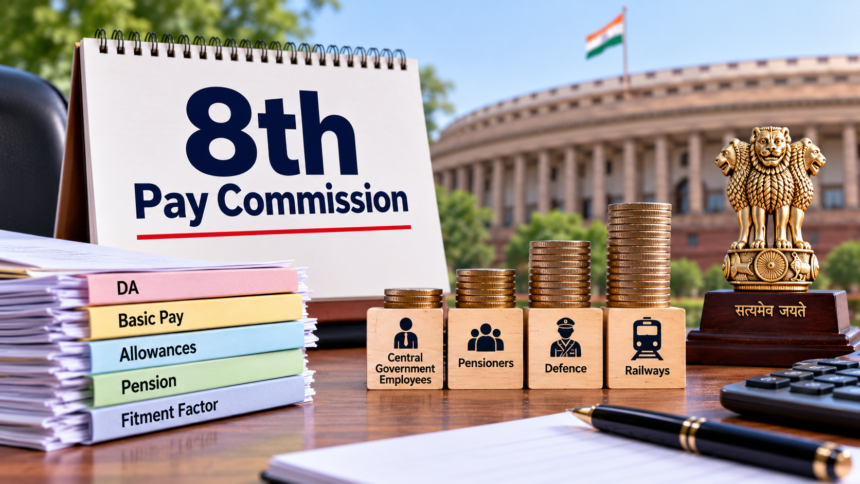
The 8th Central Pay Commission (CPC) is consulting central government employee organisations, pensioner associations, trade unions and other stakeholders before preparing its recommendations on salaries, allowances and retirement benefits. The commission is expected to submit its report by May 2027.
Its recommendations could affect more than 1 crore people, including approximately 50 lakh central government employees and 65 lakh pensioners. The groups covered include serving and retired personnel associated with the defence and railway sectors.
The commission is examining possible changes to the salary structure, pay matrix, fitment factor, Dearness Allowance (DA), Dearness Relief (DR), House Rent Allowance (HRA), increments, promotions and other benefits.
As part of its consultation process, the commission scheduled a visit to Mumbai on October 22 and 23 to meet employee unions, pensioner organisations, federations and other stakeholders.
1. DA Merger and Minimum Basic Salary Demands
One of the major demands raised by employee organisations is the merger of Dearness Allowance with basic pay. The issue has gained attention because DA has reached 60% of basic salary, according to the information provided in the source material.
Employee groups have referred to the 7th Pay Commission’s position on merging DA with basic pay when it exceeds 50%. However, as of June 2026, the government had not officially announced such a merger.
The demand is significant because basic pay influences several other salary components, including provident fund contributions, pension benefits, gratuity and certain allowances.
Employee organisations have also proposed substantial increases in minimum basic pay. Their demands include:
- National Council–Joint Consultative Machinery (NC-JCM): ₹69,000.
- Maharashtra Old Pension Organisation: ₹65,000.
- All India Defence Employees Federation (AIDEF): ₹69,000.
Meanwhile, the Indian Railways Technical Supervisors Association (IRTSA) has proposed a minimum basic salary of ₹52,600, taking modern economic conditions into account. It has also called for changes to the pay fixation factors.
The Railways Senior Citizens Welfare Society (RSCWS) has suggested calculating minimum pay using the price index applicable on January 1, 2026.
2. DA Hike and Fitment Factor: What Employees Want
Apart from a possible DA merger, employee organisations have submitted proposals for changes to Dearness Allowance and its calculation.
NC-JCM has called for a wage model linked to inflation. The Maharashtra Old Pension Organisation has demanded a minimum 4% DA increase along with a merger of DA with basic pay when it reaches 50%. AIDEF has sought compensation adjustments that more closely reflect inflation.
The fitment factor is another important issue under discussion because it is used to determine revised basic pay when a new pay structure is introduced.
IRTSA has proposed higher fitment factors for Level 6 railway safety-category posts. Its suggested factors are 2.92, 3.50 and 3.80.
These proposals reflect the different approaches employee organisations want the commission to consider while preparing its recommendations.
3. AIDEF Seeks Changes to the DA Calculation Formula
AIDEF has also requested a review of the existing Dearness Allowance calculation method in a second memorandum submitted to the 8th Pay Commission.
The federation argues that the current formula gives greater weight to certain expenditure categories whose costs are relatively stable. According to its submission, employees, particularly those in lower pay grades, spend a significant share of their earnings on essential expenses such as food, education, healthcare, house rent and medicines.
AIDEF believes the calculation method should better reflect these household expenses when determining inflation-linked compensation.
Whether these proposals are accepted will depend on the commission’s assessment and its final recommendations.
4. When Will the 8th Pay Commission Recommendations Be Announced?
The commission’s terms of reference provide an 18-month period from its constitution on November 3, 2025, to submit its recommendations. On that timeline, the report is expected by May 2027.
However, submission of the report does not necessarily mean that revised salaries and pensions will be implemented immediately. The approval process and subsequent implementation could take another two to three years.
Consequently, even if the recommendations are submitted in 2027, the complete rollout could extend into 2029 or 2030.
Central government employees and pensioners will need to wait for the commission’s final report and the government’s decision to know which proposals are accepted and how their pay, allowances and pension benefits may change.
Disclaimer
This article is intended for general informational purposes only. The salary figures, allowance proposals and fitment factors mentioned above represent demands submitted by employee organisations and should not be treated as approved government decisions. The final recommendations, eligibility conditions and implementation timeline will depend on the official report and subsequent government notifications.