Central government employees and pensioners are awaiting the recommendations of the 8th Central Pay Commission (CPC), which will examine potential changes to salaries, allowances, pensions and other benefits. The commission is currently consulting employee unions, pensioner associations, federations and other stakeholders before preparing its recommendations.
The panel is expected to assess changes to the existing pay structure, including the pay matrix, fitment factor, Dearness Allowance (DA), Dearness Relief (DR), House Rent Allowance (HRA) and other benefits. Its recommendations could affect more than one crore people, including approximately 50 lakh central government employees and 65 lakh pensioners, covering personnel associated with the defence and railway sectors.
What Is the Fitment Factor in the 8th Pay Commission?
The fitment factor is a multiplier used to calculate the revised basic pay or pension under a new pay structure. It is applied to the existing basic pay to estimate the revised amount under the proposed pay commission framework.
The calculation follows this formula:
New Basic Pay = Existing Basic Pay × Fitment Factor
For example, under the 7th Pay Commission, a fitment factor of 2.57 was applied to the minimum basic pay of ₹7,000, resulting in a revised minimum basic pay of ₹18,000.
The same calculation method can be used to estimate possible salaries under different fitment factor scenarios for the 8th Pay Commission. However, these calculations do not represent confirmed salary revisions.
What Fitment Factor Can Be Expected Under the 8th CPC?
Employee unions, pensioner organisations and other representative groups submitted their suggestions and supporting data to the commission, with the submission period closing in July.
According to a report by ClearTax cited in the supplied information, some stakeholders have demanded a fitment factor as high as 3.83. The report also refers to more conservative estimates ranging from 1.83 to 2, while moderate projections fall between 2 and 2.57.
These figures represent different expectations and demands rather than officially approved rates. The 8th Pay Commission has not yet finalised a fitment factor, and the Union Government will need to consider the commission’s recommendations before implementation.
8th Pay Commission Salary Calculator: Estimated Basic Pay at Different Fitment Factors
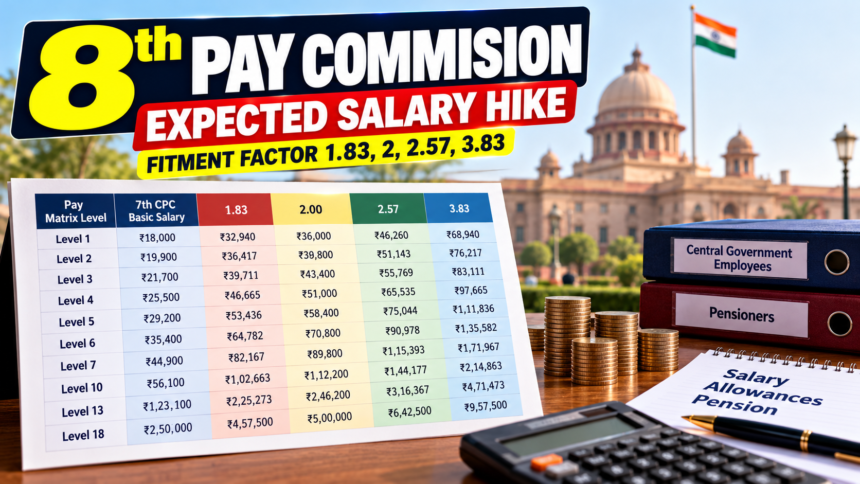
The following table shows how basic pay at selected pay matrix levels would change mathematically under fitment factors of 1.83, 2, 2.57 and 3.83.
| Pay Matrix Level | Current Basic Pay (7th CPC) | At 1.83 | At 2.00 | At 2.57 | At 3.83 |
|---|---|---|---|---|---|
| Level 1 | ₹18,000 | ₹32,940 | ₹36,000 | ₹46,260 | ₹68,940 |
| Level 2 | ₹19,900 | ₹36,417 | ₹39,800 | ₹51,143 | ₹76,217 |
| Level 3 | ₹21,700 | ₹39,711 | ₹43,400 | ₹55,769 | ₹83,111 |
| Level 4 | ₹25,500 | ₹46,665 | ₹51,000 | ₹65,535 | ₹97,665 |
| Level 5 | ₹29,200 | ₹53,436 | ₹58,400 | ₹75,044 | ₹1,11,836 |
| Level 6 | ₹35,400 | ₹64,782 | ₹70,800 | ₹90,978 | ₹1,35,582 |
| Level 7 | ₹44,900 | ₹82,167 | ₹89,800 | ₹1,15,393 | ₹1,71,967 |
| Level 10 | ₹56,100 | ₹1,02,663 | ₹1,12,200 | ₹1,44,177 | ₹2,14,863 |
| Level 13 | ₹1,23,100 | ₹2,25,273 | ₹2,46,200 | ₹3,16,367 | ₹4,71,473 |
| Level 18 | ₹2,50,000 | ₹4,57,500 | ₹5,00,000 | ₹6,42,500 | ₹9,57,500 |
These figures are estimates calculated by multiplying existing basic pay by each assumed fitment factor. They do not include allowances, deductions or other adjustments, and they should not be interpreted as confirmed revised salaries.
Who Is Leading the 8th Pay Commission and When Will Recommendations Arrive?
The 8th Central Pay Commission is chaired by former Supreme Court Justice Ranjana Prakash Desai. Pankaj Jain, a former IAS officer, serves as Member-Secretary, while Professor Pulak Ghosh is a part-time member of the commission.
The panel is gathering views from employee unions, ministries, labour groups, pensioner organisations and other stakeholders. Their submissions will help inform its examination of pay structures, allowances, pension-related provisions and other employment benefits.
Under its Terms of Reference, the commission has 18 months from its constitution on November 3, 2025, to submit its report. This places the expected deadline around May 2027, although the precise submission date should be confirmed through official announcements.
The recommendations will also need to be considered and approved by the government before implementation. The final timeline for revised salaries and pensions will depend on the decisions taken after the report is submitted. Any suggestion that the complete rollout could extend to 2029 or 2030 remains a projection rather than a confirmed implementation schedule.
Disclaimer: This article is for general informational purposes only. The fitment factors and salary figures presented are hypothetical calculations based on the supplied information and are not official 8th Pay Commission recommendations. The final fitment factor, revised pay structure, pension changes and implementation timeline will depend on the commission’s report and the Union Government’s decisions. Readers should consult official government announcements for confirmed updates.