

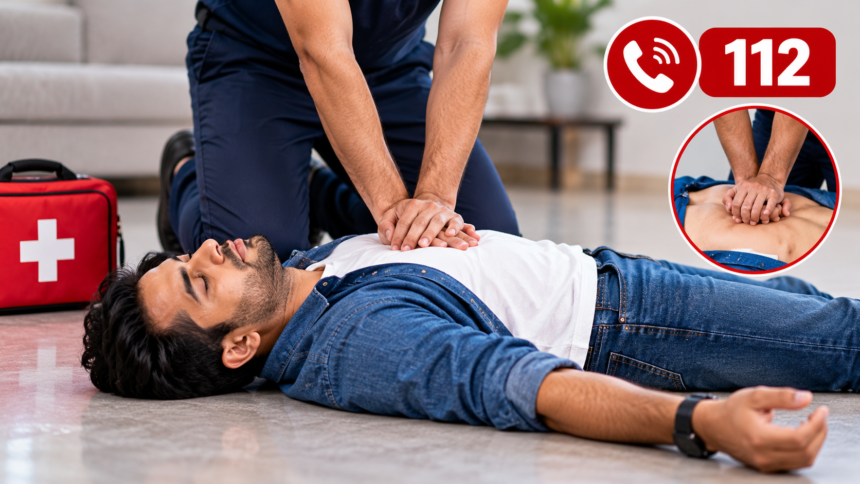
When someone suddenly collapses and becomes unconscious, staying calm and acting quickly can make a critical difference. In cases of sudden cardiac arrest, every second matters, and immediate assistance can improve the person’s chances of survival. Bystanders do not need a medical degree to provide basic help, and prompt CPR can potentially double or triple the chances of survival.
Knowing how to recognise an emergency, contact medical services and perform chest compressions can help keep a person alive until professional assistance arrives.
What to Do When Someone Suddenly Collapses
First, make sure the surrounding area is safe. Check whether the person responds when you speak loudly or gently tap their shoulders. Observe whether they are breathing normally or only gasping.
If the person is unresponsive and not breathing normally, treat the situation as a possible cardiac arrest. Call emergency services immediately, or ask someone nearby to make the call. If an automated external defibrillator (AED) is available, ask someone to bring it and follow its spoken instructions.
Do not delay emergency assistance while trying to determine the exact cause of the collapse.
How to Perform Hands-Only CPR Correctly
Hands-only cardiopulmonary resuscitation (CPR) is an important first-aid measure for a teenager or adult who suddenly collapses and is unresponsive without normal breathing. It involves chest compressions without mouth-to-mouth rescue breaths.
Place the heel of one hand in the centre of the person’s chest, put your other hand on top and interlock your fingers. Keep your arms straight and shoulders positioned over your hands. Push hard and fast at a rate of 100 to 120 compressions per minute.
Continue chest compressions until emergency professionals take over, the person shows clear signs of life, or an AED instructs you to pause. Use the AED as soon as it becomes available and follow its prompts.
First-Aid Mistakes to Avoid
During an emergency, avoid moving or lifting an unconscious person unnecessarily. If the person is unresponsive and not breathing normally, place them on their back on a firm, flat surface to perform CPR. If they are unconscious but breathing normally, their needs are different; seek emergency guidance and use the recovery position when appropriate, provided a suspected spinal injury does not make movement unsafe.
Never give an unconscious person water, food or medication by mouth. They may be unable to swallow safely, creating a risk of choking or airway obstruction.
Act quickly, call for professional help and follow emergency-service instructions rather than attempting treatments you are unsure about.
Hands-Only CPR and Traditional CPR: What Is the Difference?
Hands-only CPR focuses on chest compressions and is recommended for bystanders who witness a teenager or adult suddenly collapse outside a hospital. It offers a straightforward way to provide immediate assistance while waiting for emergency responders.
Traditional CPR combines chest compressions with rescue breaths. Compressions and breaths may be especially important for infants and children, as well as people whose cardiac arrest is associated with drowning, drug overdose or breathing-related problems.
The appropriate technique depends on the circumstances. For members of the public, recognising an emergency, calling for help, starting suitable CPR promptly and using an AED when available can be crucial while waiting for medical professionals.
Disclaimer: This article is intended for general awareness and educational purposes only. It is not a substitute for professional medical advice, certified first-aid training or emergency care. In a medical emergency, contact local emergency services immediately and follow the instructions provided by qualified responders.