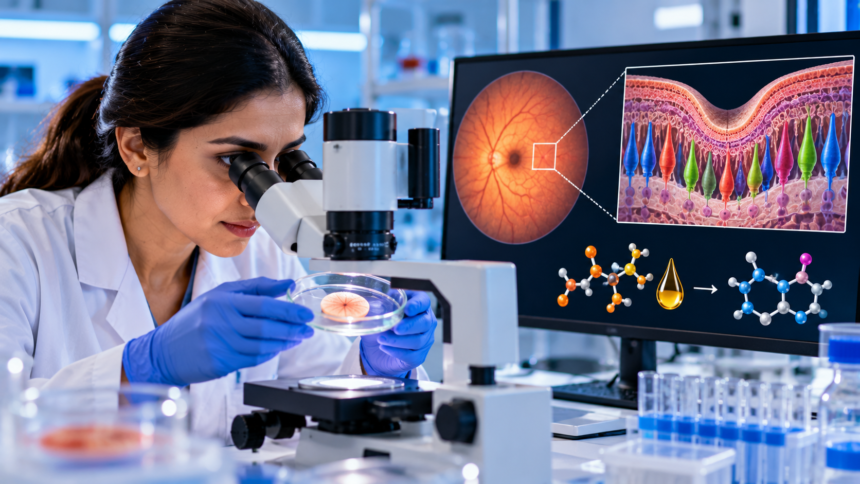
Scientists have uncovered an important detail about how the human eye develops its ability to see fine details. Researchers have discovered that a vitamin A derivative works alongside thyroid hormones to help create the specialised cells responsible for sharp central vision.
The findings challenge a scientific explanation that has remained widely accepted for nearly three decades and could help researchers explore future treatments for certain eye diseases.
How the Retina Develops Sharp Vision
The research focuses on the foveola, a tiny region at the centre of the retina that plays an essential role in detailed vision. It helps people perform everyday visual tasks such as reading, recognising faces and distinguishing small objects.
Scientists used miniature human retinal tissues, known as retinal organoids, grown in laboratory conditions to observe how the eye develops.
They found that during the 10th to 12th weeks of fetal development, some blue-light-sensitive cells initially appear in the developing foveola. By approximately the 14th week, some of these cells change into red- and green-light-sensitive cells.
Vitamin A Derivative and Thyroid Hormones Play Key Roles
Researchers identified two important biological signals involved in this transformation.
Retinoic acid, a molecule derived from vitamin A, helps regulate the development of retinal cells and limits the formation of blue-sensitive cones in the central region.
Thyroid hormones then help guide the remaining blue-sensitive cells towards becoming red- and green-sensitive cones.
Together, these processes help establish the specialised arrangement of light-detecting cells needed for detailed central vision.
Findings Challenge a Long-Standing Scientific Theory
Earlier scientific explanations suggested that blue-sensitive cells initially formed in the centre of the retina before moving towards other areas as the eye developed.
However, the new research indicates that some of these cells may actually change their identity instead of simply moving away.
This provides a different understanding of how the human retina develops its specialised structure and functions.
Potential Importance for Future Eye Treatments
The findings could contribute to future research into eye conditions such as macular degeneration and glaucoma, which can damage important structures involved in vision.
Researchers hope that a better understanding of retinal development will help them improve laboratory-grown retinal tissues. In the longer term, this work could support investigations into developing specialised cells for potential vision-restoration therapies.
However, the research is still at an early stage, and further testing is required before any such treatment becomes available.
Scientists have also clarified that the findings do not mean taking additional vitamin A supplements will improve eyesight in adults. The discovery concerns the biological processes involved in eye development before birth, rather than a new supplement-based treatment for vision problems.