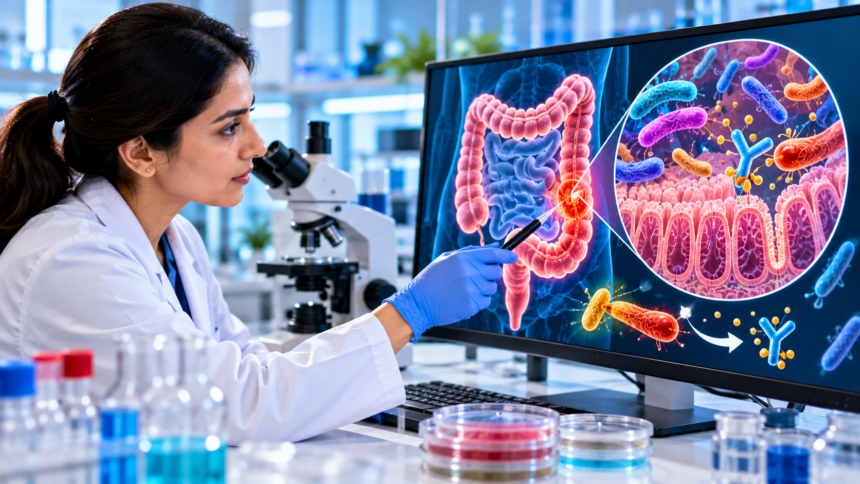
A major scientific discovery has revealed how a common intestinal bacterium can damage the protective lining of the colon and contribute to conditions associated with colorectal cancer. Researchers have identified a previously unknown interaction between a bacterial toxin and a protein found in intestinal cells.
The discovery could open new possibilities for developing treatments that prevent harmful bacteria from damaging the gut.
Researchers Identify the Missing Link
The investigation focused on Bacteroides fragilis, a bacterium that can be present in the intestines of healthy people. Certain strains produce a toxin known as BFT, which has been associated with inflammation and the development of colon tumours.
Scientists had already established that this toxin could damage E-cadherin, a protein that helps maintain the protective barrier between intestinal cells. However, they had not understood how the toxin initially attached itself to those cells.
The new research identified claudin-4 as the missing receptor that allows the toxin to connect with intestinal cells.
How the Bacterial Toxin Damages the Colon
Researchers used CRISPR gene-editing technology to investigate which proteins were necessary for the toxin to attach to colon cells.
Their experiments revealed that when the gene responsible for producing claudin-4 was disabled, the bacterial toxin could no longer attach to the cells and carry out its damaging activity.
Claudin-4 normally helps neighbouring cells remain connected and supports the intestinal barrier. The discovery showed that the bacterial toxin uses this protein as an initial attachment point before damaging E-cadherin.
This process can weaken the colon’s protective lining and contribute to inflammation, creating conditions associated with tumour development.
Experimental Molecular Decoy Shows Promise
The researchers also explored whether the harmful interaction could be blocked.
They developed a molecular decoy containing claudin-4 sequences. Instead of attaching to the receptors on colon cells, the bacterial toxin attached to these decoy molecules.
In experiments involving mice, this approach successfully protected intestinal tissue from toxin-related damage.
The findings provide an early indication that blocking the toxin before it reaches intestinal cells could become a potential treatment strategy.
More Research Needed Before Human Treatments
Although the discovery represents an important step in understanding the relationship between gut bacteria and colorectal cancer, the experimental approach has not yet been established as a treatment for people.
The researchers still need to determine whether the molecular decoy can be developed into a safe and effective therapy for human use. They are also investigating ways to improve the approach using other biological compounds.
The study highlights how microorganisms living in the digestive system can influence intestinal health. It also provides scientists with a new target for investigating ways to prevent bacterial toxins from damaging the colon.