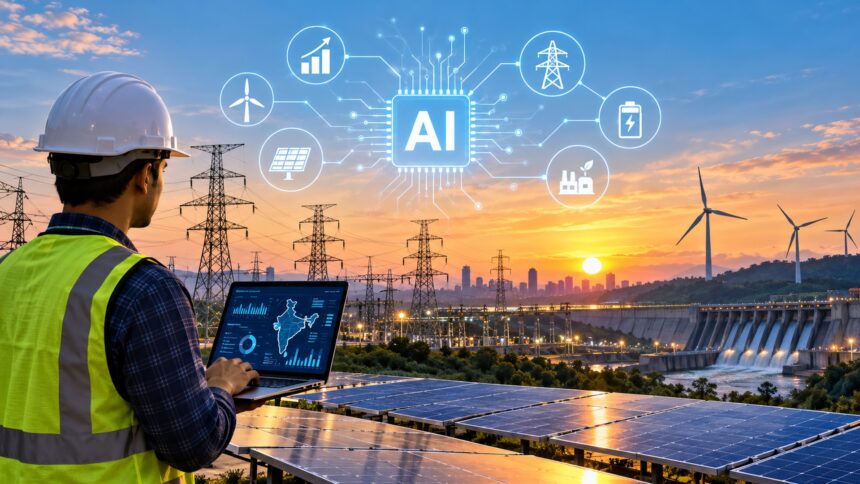
Artificial intelligence (AI) is expected to play a significant role in improving India’s power sector by enhancing electricity forecasting, strengthening grid reliability and supporting better decision-making. The technology could also create new opportunities for startups and young innovators to develop practical solutions to challenges across the electricity industry, said Central Electricity Authority (CEA) Chairperson Ghanshyam Prasad.
Speaking at the Making the Indian Power Sector AI Enabled event, Prasad highlighted how AI could improve efficiency across the electricity value chain and encourage innovation in the sector.
India’s Power Sector Needs Advanced Technology
Prasad said India’s ambition to become a developed nation by 2047, expand manufacturing and accelerate economic growth would require an electricity system that is reliable, affordable, resilient and increasingly clean.
He emphasised that electricity has become much more than a basic infrastructure service, serving as the foundation for the country’s digital economy, industries, cities and modern life.
He also noted that major innovations in the power sector could emerge from young people and students, rather than only from large corporations or established research institutions.
How AI Can Improve Electricity Generation and Distribution
India’s power sector is moving beyond conventional centralised systems towards a more complex network that includes renewable energy, battery energy storage systems, electric vehicles, distributed power generation, smart grids and digitally connected infrastructure.
According to Prasad, the challenge is not limited to generating more electricity. It is equally important to ensure that power reaches consumers at the right place and time, with the reliability and quality required by households and industries.
AI can help address these challenges in several ways. Vibration analysis and thermal monitoring can identify potential faults in turbines, generators and other critical equipment before they cause expensive breakdowns.
In transmission networks, AI-powered monitoring, fault detection and operational data analysis can improve reliability and make better use of existing infrastructure. Meanwhile, smart meter analytics can help distribution companies forecast electricity demand, detect unusual consumption patterns and improve consumer services.
AI-based decision-support systems can also assist grid operators in predicting demand, managing network congestion and maintaining stable and secure electricity supplies.
Prasad explained that AI could help the sector move from reacting to problems after they occur towards anticipating and preventing them. However, he stressed that the technology should be judged by its practical benefits, including improved power reliability, lower distribution losses, greater safety for field engineers and easier integration of renewable energy.
Startups and Young Innovators Can Drive Change
Prasad highlighted the important role startups can play in developing new solutions for India’s electricity industry. Their ability to challenge conventional practices, test ideas quickly and combine expertise from different fields could help address problems that traditional approaches may overlook.
He encouraged young innovators to identify real-world challenges, develop useful products and ensure their solutions perform reliably, safely and economically under actual operating conditions.
The growing use of AI in the power sector could therefore create opportunities for entrepreneurs to develop technologies that meet the industry’s evolving needs.
Collaboration to Strengthen India’s AI Ecosystem
Prasad also called for greater collaboration among professionals from artificial intelligence, machine learning, data science, software development, cybersecurity and energy economics, alongside electrical engineering experts.
He emphasised that educational institutions, research organisations and industry partners should work together through internships, research projects, innovation challenges, pilot demonstrations and startup partnerships. Such initiatives can help bridge the gap between classroom learning and the practical application of new technologies.
Prasad said India’s goal should extend beyond adopting advanced technologies developed elsewhere. The country should also focus on creating innovative solutions domestically that can be used internationally.
He urged students to remain curious, build skills across disciplines and experiment with new ideas, noting that young innovators have an opportunity to shape the future of India’s power sector through technology and entrepreneurship.